|
Spades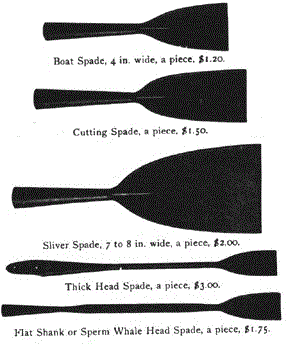
Portion of an advertisement by Frank E. Brown, New Bedford, ca 1905.
Spades were essential tools in the process of cutting up a whale. These flat-bladed implements, except for the gouge spade, had a chisel cutting edge and were mounted on wood poles via a socket at the end of the spade. After the 1850s, spade blades were typically made of cast steel, which held a cutting edge far better than the earlier wrought iron, essential for repeated use. The sockets of these spades were forge welded closed, adding strength, and they were secured to the pole with a nail, screw, or pin. Boat Spades
Thick Boat Spade.
Blade is 3-1/2" wide, 7" long, 5/8" thick, sharpened all three edges. The initial cut on a whale was made with a boat spade, carried in the whaleboat. There were two types of boat spades: thick and thin. The thick boat spade, an earlier design, was the only spade used during the capture of a whale. Its heavy 5/8" thick blade was sharpened on the sides and front chisel edge. This spade was used to stop a running whale after it was harpooned, a process known as "spading flukes." This involved cutting the tendons at the base of the whale's tail to immobilize it. The operation required great skill and bravery, as it involved maneuvering the whaleboat under the whale's upraised tail and cutting the tendons quickly. This dangerous technique was not attempted in the later years of whaling. James T. Brown, writing in The Whale Fishery in 1887, confirmed this: "Spading flukes is one of the lost arts of the fishery, and may never again be revived, but will live with the whalemen from generation to generation." After the whale was killed with a lance, the boat spade was used to cut holes in the body to fasten the line for towing the carcass to the whaleship. 
Thin Boat spade.
Blade is 3-1/8" wide, 6-1/2" long, 1/8" thick. Note short warp rigged to pole. As spading flukes fell out of practice, the heavy boat spade was replaced by the thin boat spade, used solely for cutting towing holes in the carcass. The thin boat spade was also employed on the whaleship for removing blubber from the whale, then referred to as a narrow cutting spade to distinguish it from the standard cutting spade, which had a slightly wider blade. The cutting spade's blade was four to five inches wide, while the narrow cutting spade's blade was no more than four inches wide. Cutting Spades
Cutting in, ca 1905. Note outrigger
planks and safety ropes. 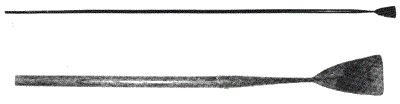
Cutting spades. Blade is 4-7/8" wide, 9-1/4" long, 1/8" thick.
Length including pole is 12' 9". The spades used from the cutting stage were mounted on very long spruce poles, around twenty feet in length, to span the distance from the stage to the whale carcass below. These cutting spades were securely pinned through their sockets to the poles to prevent loss. The blubber was cut into a long spiral strip about six feet wide, known as a blanket. As the blanket was hoisted up using a large iron blubber hook and tackle rigged from the mast to the windlass, more blubber peeled off, and the whale was rolled over in the water. 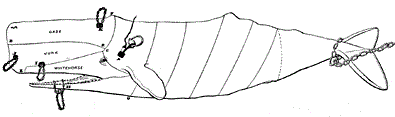
Method of cutting in a sperm whale. From The Marine Mammals of the
North-western Coast of North America and The American Whale Fishery,
by Charles M. Scammon.
The cuts made by the cutting spades formed a line called the scarf, and the process was known as scarfing. The scarf, which defined the width of the blanket, was made by successive thrusts of the narrow cutting spade. A narrow spade was used because blubber was difficult to cut, and a wide spade, making a longer cut with each thrust, would encounter more resistance and thus not cut deep enough. Each cut was angled relative to the previous cut, resulting in a slightly zigzag line rather than a straight one. This intersecting of angled cuts ensured a continuous scarf, which was easier than trying to connect two in-line cuts. 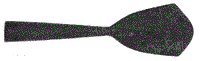
Cutting spade ground with a leaning edge.
Blade is 4-1/8" wide, 6-1/4" long, 1/8" thick. The wider cutting spades were employed to cut free the flesh adhering to the blubber and binding it to the carcass while the blanket was being raised, a process known as leaning up. These spades often had a pronounced curvature on the cutting edge, known as a leaning edge. Throughout the cutting-in process, spades dulled or were boned (struck bone), necessitating continuous sharpening on the grinding wheel. Sliver Spades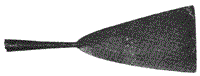

Top: Sliver spade. Blade is 7-5/8" wide, 13-1/2" long, 3/16"
thick, overall length is 21".
Bottom: Sliver spade on short pole for use in blubber room. Blade is 8" wide, 9-1/2" long, 3/16" thick, overall length is 19-1/2", overall length including pole is 56". The broadest of all spades was the sliver spade, with a blade six to eight inches wide. It was mainly used for decapitating a whale during the cutting-in process. The sliver spade severed the blubber and flesh pieces, called slivers, connecting the head and body of the whale. Sometimes, it was also used as a blubber room spade to cut the blanket pieces, which were lengths of the blanket about fourteen feet long, into smaller pieces called horse pieces, approximately six feet long (the width of the blanket piece) and one foot wide. These horse pieces were then taken to the mincing horse on deck for mincing before boiling. When used in the blubber room, sliver spades were mounted on short poles, but when used for decapitating a whale, they were mounted on long cutting-spade poles. Throat, or Bone Spades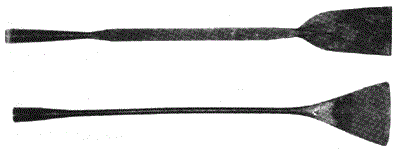
Flat shank throat spade (top) and round shank throat spade (bottom).
Flat shank spade blade is 4" wide, 8" long, 3/16" thick, overall length is 40-3/8". Round shank spade blade is 6-3/8" wide, 8-3/4" long, 1/8" thick. overall length is 36-3/4". There were two types of throat spades: flat-shank and round-shank, also known as bone spades. Both types were used to cut long passages in the head for securing the head strap or throat chain, and for removing the baleen, or bone (hence the name bone spade), from baleen whales. Their long shanks were made of soft wrought iron, allowing them to bend easily while cutting long passages around jaw bones and not break due to the carcass's motion in the water while the spade was lodged deep in the head. The flat shank had a rectangular cross-section, about 1" to 1-1/4" wide by 3/8" thick, while the round shank was about 5/8" in diameter. Bone spades, or throat spades, were approximately three feet long overall. Functionally, there was no difference between the round shank and the flat shank. However, in an advertisement by Frank E. Brown, the last spade is referred to as a "Flat Shank or Sperm Whale Head Spade." 
Back to top of this page
Back to Main Menu Harpoons, History, Knives, Lances, Links, Markings, Non-Whaling, Patents, Poison, Shoulder-gun Irons, Shoulder-Guns, Single Flue, Spades, Swivel Guns and Irons Toggle Irons, Two Flue, Whaling, Bibliography, © Website originally created by Thomas G. Lytle.
|
|


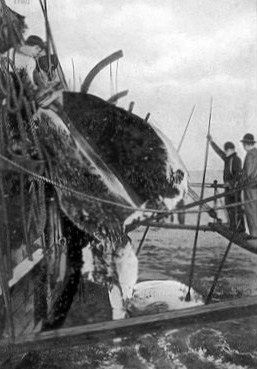 The process of cutting up a whale and removing the blubber and baleen (whalebone) was known as cutting in. This was achieved with several types of spades, each designed for a specific function. During cutting in, officers using the spades stood on a stage or planks rigged above the whale, which was tied alongside the starboard side of the whaleship with its flukes forward. Initially, the cutting stage was simply a twelve-inch-wide spruce plank suspended over the vessel's side by ropes. Positioned forward of the gangway at one end and aft of it on the other, these planks varied in length depending on the whaleship's size. This simple stage was eventually replaced by the outrigger stage around the Civil War era, though the simple stage continued to be used alongside the outrigger stage. The outrigger stage was an eighteen-inch-wide plank about twenty feet long, braced out from the side of the whaleship by boards about ten feet long, tied or bolted to the ends of the stage. Officers stood on this stage, facing the whaleship to cut the whale lying between the stage and the vessel. For safety, a rope was suspended on iron poles about three feet high along the inboard length of the stage. The entire outrigger was suspended by tackle from davits or the mast and hoisted up vertically when not in use.