|
Boarding Knives, Mincing Knives, Mincing Machines and Leaning KnivesBoarding Knives
Boarding knife and sheath.
Length is 29-3/4", length including pole is 48-3/4". Blade is 1" wide and 1/4" thick.
Cutting-in -
Boarding knife -
Mincing Knives -
Mincing Machines -
Sowle and Carsley mincing machine -
Kilburn Fly-Mincer -
Cunningham mincing machine -
Hunter blubber-cutting machine -
Ricketson blubber-cutting machine -
Leaning Knives
Cutting-inWhen "cutting in" – the process of removing blubber from a whale – the blubber was sliced by spades under the direction of the second mate. It was cut into six-foot-wide strips and hoisted up to the mast block using heavy tackle and a blubber hook. These large strips, about 14 feet in length, were referred to as blanket pieces (see photo on the left and the description under "Spades"). When the blanket piece was raised as high as possible, The boarding knife had a long, double-edged blade similar to a sword, mounted on a short wooden handle via a closed-seam socket forged to the blade's end. It was typically secured with a screw or pin through the socket and handle. A Turk's head knot was often tied at the base of the blade where it joined the socket to prevent a bare hand from sliding along the oil-soaked handle onto the sharp blade during use. After steel became widely available in the mid-1800s, boarding knife blades were made of steel because it maintained a sharp edge better than wrought iron. When not in use, the boarding knife was kept in a wooden case made by the whalemen on board. Occasionally, boarding knives were fashioned from discarded swords or Navy cutlasses, repurposed for use as boarding knives as a cost-saving measure. Mincing Knives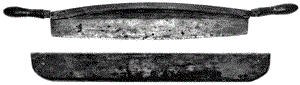
Mincing knife and sheath.
Length of the blade is 24-1/4" After the blanket piece was cut into horse pieces, each about six
Photograph by Albert C. Church
A mincing knife featured a long, 24-inch blade that was 4 inches wide and only about 1/16 of an inch thick, with a wooden handle at each end. The top of the thin blade was reinforced with a metal rib running the entire length, while the lower edge was sharpened for slicing the blubber. Cutting blubber required a sideways slicing motion rather than a straight downward plunge. One man would pull the horse piece along the plank with a small hand hook, while another would slice it into bible leaves with the mincing knife. When not in use, the mincing knife was stored in a wooden case made by the whalemen on board. In the northern whale fisheries of the Dutch, English, and Scots, blubber was not boiled down into oil on board the ship. Instead, it was cut into small pieces and stored in casks to be taken back to shore for oil extraction. This process, known as "making off," was done leisurely when the crew was not actively pursuing whales. The exception was sperm oil, which had to be extracted as soon as possible by boiling the blubber to prevent it from becoming a dark, thick mass. Mincing Machines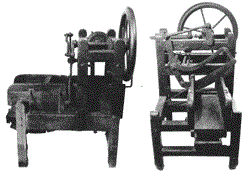
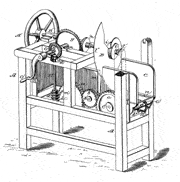
Sowle & Carsley Mincing Machine.
Height is 42-1/2", width is 27-1/2", length is 33". While the design of the mincing knife remained unchanged, some mincing machines were developed to replace hand mincing. These machines required only one man to load horse pieces and turn a hand crank, producing more uniform bible leaves. An early U.S. patent for a "whale blubber mincing machine" was granted to B. Taber of Fairhaven, Massachusetts, on August 11, 1821, though details of this invention are unknown due to a fire at the Patent Office in 1836 that destroyed many records. Another early U.S. patent, granted to W. Ball of New York City on April 25, 1822, was for a "knife for cutting up blubber," but those records were also lost in the same fire. There were at least four other patented mincing machines, but one stood out for its widespread use and serves as a good example of these whaling tools. This particular mincing machine, illustrated above, was patented by George W. Sowle and William Carsley of
Patent drawings for Sowle
and Carsley mincing machine. The conveyor belt was made of leather, with wooden strips secured across its width. Nail points projected from these strips to grip the blubber as it moved through the machine. A ratchet prevented any reverse motion. The mincing blade was attached to a frame fixed directly to a jointed crank mechanism. The patent specifically claimed the method of fixing the knife blade directly to the crank, as seen in the photo above. Other patents for mincing machines were similar and are not discussed in detail here. Patent drawings and brief descriptions will suffice. For more detailed information about a particular mincing machine, please send me an email with your request. G. and J. J. Kilburn of Fall River, Massachusetts, received a U.S. Patent on November 16, 1841 (U.S. Patent No. 2,368) for their invention called the "Fly-Mincer." The patent claims specified: "We do not claim the knife on the wheel or the opening in the face of the wheel, nor the beveled edge of the wheel, as these have long been known and used separately, as also the hopper; but ... What we do claim as our invention, and desire to secure by Letters Patent, is ----- Making the back face of the wheel beveled toward the periphery, and the beveled opening through which the blubber passes after it has been cut, in combination with the curved knife, and these thus combined in combination with the arrangement of the hopper, so that the part cut shall not be entirely severed from the mass in the hopper, all substantially as herein specified."
Patent drawings for G. &
J.J. Kilburn mincing machine. Patrick Cunningham of New Bedford received a patent for a hand-cranked mincing machine on September 28, 1880 (U.S. Patent No. 232,691). This machine featured a continuous motion, with bible leaves cut by a spiral knife whose radius increased from the center outward. This design provided the necessary drawing action. Cunningham explained:
Whale blubber is spongy, and to slice it uniformly, a specific proportion of drawing stroke to vertical cut is required. Uniform thickness of slices is crucial for proper oil rendering. The knife's spiral or screw form on its shaft enables it to follow the motion of the feed, preventing the blubber from crowding against the knife."
Patent drawing for the P. Cunningham
mincing machine is shown above. Similarly, J. Morrison Hunter of New York City patented a blubber-cutting machine on May 8, 1860 (U.S. Patent No. 28,179). He called his invention a "circular cutter mincing machine." Unlike Cunningham’s, Hunter's device sliced completely through the blubber rather than mincing it into bible leaves. This hand-cranked machine featured a stationary clamp that the cutting wheel's edge passed through, continually cleaning and sharpening the blade. There was no need to adjust the blade's height or position as it wore down from sharpening. Hunter explained:
Patent drawings for
J. M. Hunter blubber cutter. Henry H. Ricketson of New Bedford was posthumously awarded a patent through his administratrix, Lydoriann Ricketson, on December 14, 1852 (U.S. Patent No. 9,478) for a device designed to cut blanket pieces into horse pieces. Similar to mincing machines, this device was used in processing blubber and is thus relevant here. Ricketson's machine employed "two or more" spiral knives that sliced through the blanket, passing through fluted slots in the rollers supporting the blanket. In his patent, Ricketson explained: "When removing blubber from a whale, it is generally taken in the form of a strip, cut or peeled in a spiral manner from
Patent drawing (partial) for
H.H. Ricketson blubber cutting machine. The task of reducing blanket pieces to horse pieces, or cutting them laterally, is performed by this machine. For this, the knives must cut with a drawing stroke and advance in the direction of the moving blanket piece; otherwise, they could not cut it properly. If a cutting wheel of a single plane plate were used, the forward movement of the blanket piece would have to stop while the knife passed through. With the spiral slicing knives, as one passes through the blubber, the next knife makes another drawing and descending cut." Ricketson's machine was impractical and likely never used. Maneuvering the large blanket piece into the machine would have been nearly impossible, and the machine's size on a crowded deck would not have been feasible. Mincing machines, in general, had mechanisms that could jam or break and required maintenance. Sharpening the blades was more difficult and time-consuming compared to using a hand mincing knife. Additionally, mincing machines were significantly more expensive than simply having several mincing knives on board. As a result, mincing machines were not popular, and hand mincing remained the preferred method. Leaning Knives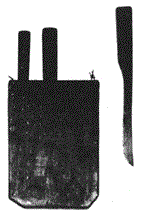
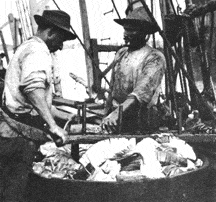
Leaning knives were essentially large butcher knives used by whalemen to trim away small bits of flesh, known as "lean," from the blubber. This was done to prevent the flesh from discoloring the oil during the trying-out process. The task of trimming the blubber was handled by the blubber room gang. Additionally, because the blubber of blackfish and smaller whales was much thinner, leaning knives were sometimes used to mince it instead of the traditional mincing knives. When not in use, leaning knives were stored in a wooden case crafted by the whalemen on the whaleship. 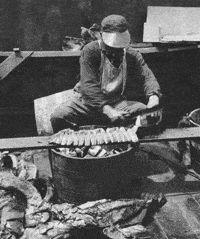
Cutting blackfish blubber with leaning knives.
Photograph by Albert C. Church. 
Back to top of this page
Back to Main Menu Harpoons, History, Knives, Lances, Links, Markings, Non-Whaling, Patents, Poison, Shoulder-gun Irons, Shoulder-Guns, Single Flue, Spades, Swivel Guns and Irons Toggle Irons, Two Flue, Whaling, Bibliography, © Website originally created by Thomas G. Lytle.
|
|


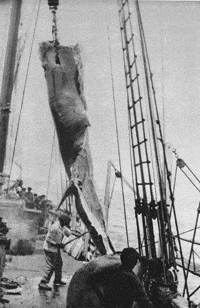 known as "two blocks" (when the two large pulleys, or blocks, met), another blubber hook, blubber toggle, or chain-strapped lower block was attached through a hole made with a boarding knife. A strain was then applied to the second tackle to support the blanket, and the hoisted blanket was cut off above the new attachment point with the boarding knife. This process, known as "boarding" – bringing the blanket piece on board – was the third mate's responsibility.
 feet long and one foot wide, these sections were taken to the mincing horse. The mincing horse consisted of 2-inch planks, approximately 1 foot wide and 3 feet long, laid across a tub to collect the minced blubber. Several wooden pegs along the sides of the planks held the horse piece in place during mincing. To facilitate the "trying out" process, where blubber was boiled down to extract oil, the surface area of the blubber was increased by slicing it into thin, 1-inch thick slices. These thin slices remained attached to the blackskin, resembling the pages of a book attached to its spine, and were called "books" or "bible leaves." The process of slicing the horse pieces into bible leaves was known as mincing, performed with a mincing knife.
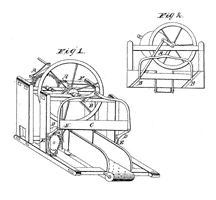 New Bedford, Massachusetts, on October 6, 1843 (U.S. Patent No. 3,290). Their hand-cranked machine automatically fed the horse piece forward the correct distance on a conveyor belt at the bottom of a wooden trough. The horse piece was then sliced nearly through by a drawing stroke of a mincing blade. The blade would return to its starting position as the horse piece advanced for the next cut. This alternating action was achieved by turning a hand crank, which was connected to a large flywheel to ensure smooth operation. Gears and a cam linked the conveyor belt and mincing blade to the crankshaft.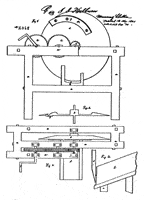
 "It will be observed that the knife makes a complete revolution with each cut, allowing the entire length of the knife-edge to pass through the blubber laterally, while the vertical cut, due to the spiral shape of the knife, engages only about one-eighth of the knife-edge length.
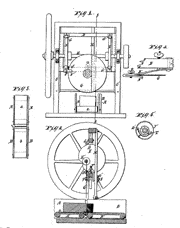 "My machine delivers a very rapid drawing cut, a feature not matched by previous machines. The design allows the knife to revolve freely, clearing itself of fat without requiring positive rotary motion during ascent. It permits the cutter to operate at any required depth as the disk wears down, with no need to adjust other machine parts. The slices are moved aside by the disk's rotation without disrupting their close arrangement. The disk maintains uniform velocity during its descent, which can be optimized for practical use, and it ensures the cutting-edge remains keenly sharpened and accurate."
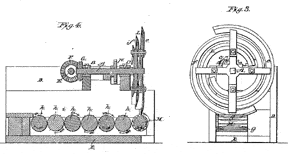 head to tail, with the carcass rolled over during the process. This piece, usually nine to eleven inches thick and very tough, is called a 'blanket piece.' These strips are cut into 'horse pieces,' which are then sliced into 'books' and boiled in large tubs to extract the oil.