|
Explosive Hand-darted Harpoons
Explosive Hand-darted Harpoons -
Albert Moore Explosive harpoon -
Charles Burt Explosive Harpoon -
Theodore Briggs Explosive Harpoon -
Silas Barker Explosive Harpoon -
Zeno Kelley Explosive Harpoon -
Charles Freeman Explosive Harpoon
When whalemen declined to use poison harpoons, they sought an alternative method to simultaneously attach to and kill the whale. This innovation was especially desirable in the icy northern fisheries. Consequently, the development of the harpoon shifted from poison to explosives. Albert Moore Explosive harpoonThe first explosive hand-darted harpoon in the United States was patented by Albert Moore of Hampden, Maine, in 1844 (U.S. Patent No. 3,490, " As soon as the harpoon is thrown into the whale and fastened to it, the wooden pin is broken by the power of the whale pulling on the tow-line attached to the harpoon. The fluke of the harpoon will open or turn upon the iron rivet, breaking the vial, producing friction, and causing the powder to explode, which will destroy the whale." Moore described the explosive's preparation, noting that any suitable explosive could be used. There was no fuse or other positive means to ignite the explosive. If the explosion was strong enough to kill the whale, it would likely destroy the harpoon itself. No examples of the Albert Moore harpoon have been found. Charles Burt Explosive Harpoon
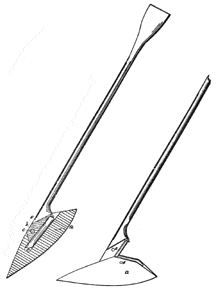
Above: Charles Burt Explosive Harpoon (tip missing). Length without tip is 36-3/4". In 1851, Charles Burt of Belfast, Maine, patented another explosive harpoon (U.S. Patent No. 8,073, May 6, 1851). Unlike Moore's design, Burt's harpoon was not meant to kill the whale through explosive force alone but to fire the harpoon tip like a bullet into the whale. The
Charles Burt Explosive Harpoon Patent Drawings
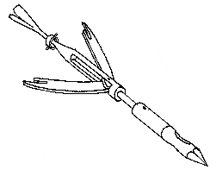
Theodore Briggs Explosive HarpoonIn 1860, Theodore Briggs of Philadelphia, Pennsylvania, patented an explosive hand-darted harpoon (U.S. Patent No. 30,869, Dec. 11, 1860). Briggs’ harpoon featured pivot barbs on the shank behind the explosive head, designed to open outward and secure Pivot barbs were installed in a mortise through a widened section of the shank and pivoted on a single, common pin. These barbs were spring-loaded open by small leaf springs mounted to the shank. A sliding collar over the ends of the barbs held them in the darting position. The aft end of the shank had a forged socket for mounting the iron to a wood pole, similar to standard hand-darted harpoons. In his patent specifications, Briggs described the operation of his harpoon: Patent drawings for the
Theodore Briggs explosive harpoon. It is thrown by hand in the usual manner, so as to cause it to penetrate the skin and thick mass of blubber of the whale, and the tubular end then coming in contact with bone is suddenly arrested, while the momentum of the body and balance-shaft of the implement causes the breaking of the wooden pin... and the consequent driving up of the stem end... against the percussion-cap on the nipple... exploding it and the powder... thus destroying the life of the animal almost instantly. During penetration, the resistance of the blubber caused the sliding collar to move back, releasing the spring-loaded pivot barbs, which would then open to secure the whale. If the wooden shear pin was weak, the initial impact against the whale's side could cause an explosion before penetration. Conversely, if the shear pin was strong enough to resist breaking during penetration, and the harpoon did not hit bone, the mechanism would not function. It was highly unlikely that the harpooner could dart the iron to hit bone. The Briggs harpoon never gained popularity, and no examples of this explosive harpoon have been found. Silas Barker Explosive Harpoon
Silas Barker centerHarpoon.
Length is 31-1/4", head is 3-3/4" long, 1" thick. In 1865, Silas Barker of Hartford, Connecticut, patented another explosive hand-darted harpoon (U.S. Patent No. 46,437, Feb. 21, 1865). This harpoon propelled an explosive head deeper into the
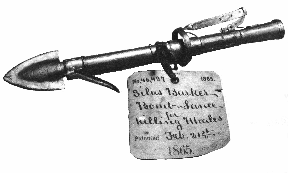
Silas Barker Patent Drawings and patent Model.
Zeno Kelley Explosive Harpoon
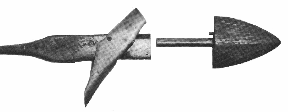
Author's interpretation of the Zeno Kelley Explosive Harpoon (no example found) Zeno Kelley operated a watch repair business in New Bedford, where he also repaired and adjusted Zeno Kelley Explosive Harpoon Patent Drawings
In his patent, Kelley noted that the harpoon could also be used as a gun harpoon, which could be fired into a whale from a shoulder gun. For this purpose, Kelley suggested mounting the harpoon on a short rod to fit a gun barrel instead of an iron pole. To attach the whale line, Kelley provided a cast iron slide that fit loosely around the harpoon shaft, forward of the socket. To reduce the recoil forces that could snap the whale line due to the sudden tension when the harpoon first left the gun barrel, a coil spring was positioned around the shaft between the socket and the slide. This spring acted as a shock absorber to lessen the sudden impact on the whale line. Kelley had used this feature in an earlier 1867 patent for a non-explosive gun harpoon. The inclusion of this sliding collar and coil spring feature in the explosive harpoon seems to have been an afterthought. Charles Freeman Explosive Harpoon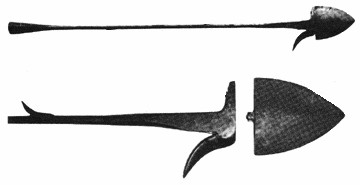
Charles Freeman Explosive Harpoon (above) and Detail (below). Length is 41". Head is 4-3/4" long, 4" wide and 11/16" thick. In 1872, Charles Freeman of Brewster, Massachusetts, patented an explosive-head harpoon (U.S. Patent No. 126,388, May 7, 1872). According to James Templeman Brown in "The Whale Fishery and Its Appliances" (1883), this harpoon, charged with 3/4 lb. of gunpowder, was used to kill finback whales off the coast of Cape Cod in Massachusetts. The Freeman harpoon featured a hollow cast iron head filled with gunpowder. Attached to the rear of the head was a time fuse with a
Charles Freeman Harpoon
Patent Drawings Some examples of the Freeman harpoon included a small safety lever to prevent inadvertent activation of the barb. Most Freeman harpoons were made with two small stationary barbs brazed or forge-welded to the shank to make withdrawal more difficult, preventing the harpoon from working its way out. However, some examples did not have these small shank barbs. Several Freeman harpoons were produced, but they never became very popular. This was likely because the explosion would destroy the harpoon and its barb, and possibly even blow the iron back out of the whale. 
Back to top of this page
Back to Main Menu Harpoons, History, Knives, Lances, Links, Markings, Non-Whaling, Patents, Poison, Shoulder-gun Irons, Shoulder-Guns, Single Flue, Spades, Swivel Guns and Irons Toggle Irons, Two Flue, Whaling, Bibliography, © Website originally created by Thomas G. Lytle.
|
|


 March 16, 1844). Moore’s harpoon, inspired by the single-flued design, featured a single barb that pivoted on an iron pin. In the darting position, a small wood pin was inserted through holes in the head and shank. The barb had a cavity that opened to the rear, accommodating a small glass vial of explosive held in place by a wood peg. Moore detailed the operation of his harpoon in the patent specifications:
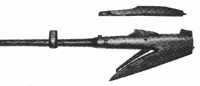 design resembled the single flue-irons, with a trigger nested under the flue.
 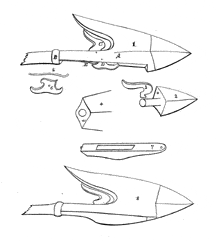 This trigger was depressed by the resistance of the whale's blubber when withdrawal forces were applied, activating a firing mechanism in the head. A half-inch diameter stud at the rear of the separable tip was inserted into a bore acting as a gun barrel. A linen patch made the stud a tight fit until it was propelled by the explosive. During darting, the single flue protected the trigger. When the whale line was pulled, the trigger depressed, releasing the firing mechanism. According to the patent specifications, this action caused the separable tip " ...to be forced off by the explosion, in order to kill the whale immediately."
  the whale after the head exploded. The harpoon head consisted of two metal tubes connected end to end by a threaded plug. The plug had a nipple for a percussion cap extending into the rear tube of the head and a small hole to transmit fire from the percussion cap to the forward tube. The forward tube had a solid, pointed tip for penetrating the whale during darting and was filled with gunpowder. The explosive head was not forged to the shank but fit loosely over its end. A small wooden
 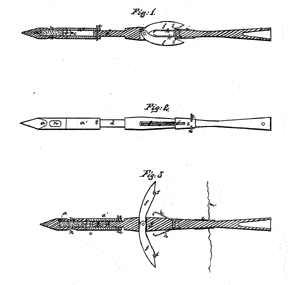 shear pin held the head to the shank for darting, keeping the shank's end a short distance from the threaded plug with the percussion cap.
 whale before detonating. The hollow head was filled with gunpowder and sharp, angular pieces of steel to act as shrapnel. A long hollow tube filled with explosive was screwed into the rear of the head, acting as a time fuse. This tube ignited the powder in the head through a small hole at the tube's forward end after the propelling charge had ignited that far. The tube fit into a corresponding hole, acting as a gun barrel in the stationary portion of the head, which contained a firing mechanism.
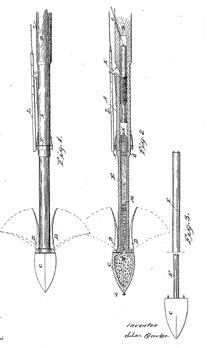 The patent specifications describe a trigger wire extending from the hammer of the firing mechanism back along the shaft of the harpoon to a crosspiece. When the iron was darted, the blubber's resistance on the crosspiece caused the wire to be drawn back, releasing the firing mechanism and igniting the explosive to propel the head farther into the whale. The crosspiece was described as a ring of thin metal positioned edgewise around the shank. The ring also attached to a "discharging-rod" that acted as a trigger, parallel to the shank. In the event that penetration was insufficient to allow the blubber to act on the crosspiece, a small line was provided by which the harpooner could manually actuate the mechanism. A large brass toggle barb secured the whale after darting. The choice of brass may have been to prevent any spark that might prematurely ignite the powder; otherwise, brass was weaker than iron and prone to corrosion when in contact with iron. This toggle barb was positioned farther back on the head to avoid damage from the explosive. More details can be seen in the patent model and drawings, which differ somewhat from the actual produced iron. The Silas Barker explosive harpoon is very rare; not many were made or used.
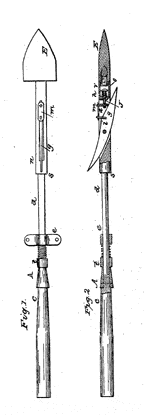 chronometers for whaleships. Whaling captains frequently gathered in his shop to discuss whaling, and Kelley became deeply involved in their activities. In 1868, he was awarded a patent for a hand-darted explosive harpoon (U.S. Patent No. 78,673, June 9, 1868). The head of this harpoon was hollow and filled with gunpowder. The harpoon was mounted on a standard iron pole and was designed to be hand-thrown. The patented feature was the mechanism that detonated the powder. A percussion cap was placed on a nipple at the rear of the explosive head. The hammer, which struck the cap, was a metal rod driven by a coil spring. This mechanism was housed in a widened section of the harpoon shaft near the head. A pin inserted through the rear of the hammer rod connected it to a sliding cover plate on the outside of the widened part of the shaft, over the firing mechanism. To cock the hammer, the plate was drawn back. A pivot barb set in a mortise of the wide section engaged the hammer and held it in the cocked position. When the pivot barb was in the streamlined darting position, and the sliding cover was drawn back, a small hole in the cover plate aligned with a corresponding hole in the barb. A small metal pin inserted through these holes kept the hammer cocked. Once the harpoon was thrown and a force applied to the whale line, the rear tip of the barb caught in the whale's flesh, causing the barb to open. This action also pulled the metal pin through the hole in the cover plate, releasing the hammer to strike the percussion cap and detonate the explosive head in the whale.
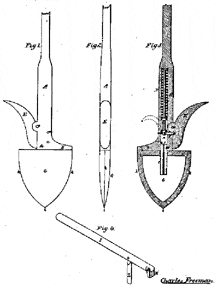 short stem. A percussion cap was placed on a nipple at the rear of the stem, fitting into a corresponding hole in the forward part of a widened shank section. This section formed a flat base on which the head was mounted. A screw through the toe of the base secured the explosive head to the harpoon. The widened shank also housed the firing mechanism. The hammer of this mechanism was a metal rod driven against the percussion cap at the base of the head by a coil spring. A small spring-loaded latch held the hammer in the cocked position. A large iron pivot barb on the side of the shank, opposite the screw securing the head, acted as a trigger. During penetration, the resistance of the blubber pushed the pivot barb toward the shank, causing the barb to press against the latch holding the hammer. This action released the firing mechanism, causing the head to explode.