|
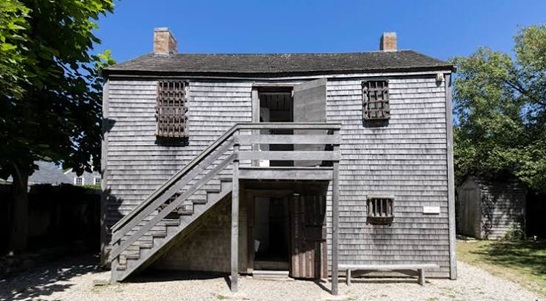
Nantucket's new Gaol - Built 1805 (after the June 1796 escape of Zeb Withers and John Clark) |
|
The Robbery of the Nantucket Bank.
Edouard A. Stackpole
|
|
Prolog: Nantucket Bank Robbed *
It happened away back in 1795, so there is no need for anyone to get nervous. The event is one of the most interesting incidents connected with Nantucket history. For a quarter of a century it was a subject for conjecture and wonder. In 1816, William Coffin and Albert Gardner published a pamphlet clearing up the actual robbery inasmuch as they had solved it, but there was a great deal more to the story – and the entire narrative suffered from the omission. For the first time, therefore, the story of the Bank Robbery appears as it actually developed. It is not only a matter of historical interest but has much more readability than many of the modern fiction stories of mystery. The first installment will be found on the third page of this issue. |
|
The Robbery of the Nantucket Bank Provided Mystery Story.
By Edouard A. Stackpole.
[Part 1.] As a community, Nantucket continues to be singularly free from incidents of violent crime. It is indeed rare to find vicious assault, murder or armed burglary in its annals, but when the events do occur they are invariably of considerable interest due to the circumstances surrounding the cases. Unquestionably, the crime which occupied the interest of Nantucket for the longest period, which, despite the lapse of a century and a half is still unsolved in many of its aspects, concerns the robbery of the Nantucket Bank in the last decade of the 18th century. The story of the Robbery of the Nantucket Bank provides all the thrills of a modern detective novel. It contains intrigue, skulduggery, a midnight robbery, "alarums and excursions," and a tremendous anticlimax. But, being an important incident in the history of such an insular community as Nantucket, the story involves personalities who were among the important figures of their time. It is because of these men, many of whom are the ancestors of islanders and other descendants who live in mainland homes, that this entire story continues to be' of exceptional and absorbing interest, forming one of the most interesting chapters in the island's history. * * * * *
The story begins on the morning of June 26, 1795 – one hundred and and fifty-one years ago. A number of people were seen gathered about the doors of the Nantucket Bank, which was located on Federal street [at the present site of the Post Office] and within a short time news spread like wild fire throughout the town – "the bank has been robbed!" As a matter of fact, the bank had been robbed of $20,000, mostly in coin, 5 nights before but the directors had sent a message to the certain stockholders residing in Boston before making the news public. It was a new and promising institution, having been launched only a few weeks before. It was supposed to have a capital of $40,000, to be paid in three installments. The State officials advised an immediate payment of the second installment, and to make this fact known at the same time the news of the robbery was made public. While the excitement grew, several more details became common knowledge. In constructing the bank's main vault, the directors had placed it in the center of the building – a room lined with iron and oak wood in alternate layers. Before entrance to the vault could be gained it was necessary to unlock five doors and two iron doors – each having a separate key. * * * * *
Jethro Hussey, Samuel Barker, Albert Gardner and William Coffin were four of the directors. The cashier was a man named Randall Rice. With the announcement of the robbery on that Friday morning in June, 1795, the fact that such a large amount as $20,000 had been taken was disguised with the words "a large sum has been stolen." Within a few hours after the startling news of the robbery had burst like a northeaster through the town, it was learned that Randall Rice had been arrested and accused of the crime. As the bank's Cashier, it was perfectly natural that Rice would be held for questioning, but the fact that he was immediately accused of the robbery was surprising- to those who had come to know him as a sober and industrious citizen. But an over-zealous investigator had attempted some swift detective work. On the floor of the vault a handkerchief was found bearthe initials "R. R." This handkerchief was covered with grease. The gallied officials knew that Randall Rice was a close friend of Joseph Nichols and son, butchers, with a shop close by, and so they decided to arrest the three on a charge of complicity in the robbery. Warrants were issued and Rice and the two Nichols were arrested on the night before the news of the robbery was announced, the three men being placed in separate rooms in James Barker's brick store on Main street. They were not allowed tc speak with one another or with any of their friends alone. On that afternoon following, a preliminary trial was held before two magistrates. In the meantime, several of the proprietors of the bank searched the homes of the accused but found nothing. The trial revealed no evidence to support the charges and the three men were released. * * * * *
Immediately two questions occupied the minds of the townspeople for the next fortnight: "Who committed the robbery?" and "How was it done?" It was conjectured that the original keys had been used to open the doors – but Rice had stated under oath that he had possession of the ¦ keys on a ring at all times. The keys were examined and the locks. A hundred speculations made the rounds. And all the while Randall Rice protested his innocence. The brief calm which followed was the proverbial one before the storm, for shortly after a quarrel broke out among the proprietors of the bank, touched off by the remark on the one hand that certain members on the other knew more about the situation than was publicly realized. This internal dissension precipitated as bitter a quarrel as the town ever knew before or since. It was a verbal (and sometimes physical) battle which lasted for over half a century. Involved in the broil were some of the most prominent men of the town. With the first years of the 19th century the flame of the feeling died a little, only to burst out with renewed violence again during the heated politics of the War of 1812. * * * * *
A number of business projects had been involved in the entire affair. One of the directors, Albert Gardner, was one of a local group being formed to accomplish a project which woul d have cornered the market in whale oil. A company of eighteen islanders were planning to purchase all the available oil upon the arrival of the whaling ships. Included in the enterprise (or "speculation," as a private document called it, were James Barker, Jonathan Jenkins, William Coffin, Joseph Chase, Uriah Swain, Silas Jones, Albert Gardner and several others. But the robbery of the bank put a financial damper on the proposition. But the very fact that such a speculation was afoot caused an immediate suspicion of the parties involved – all of which added to the confusion. In a statement written the following November, Albert Gardner wrote: "This may certify all concerned that I, the subscriber, heard Francis Joy say that, about two months gone, he heard John Elkins say that Randall Rice and Albert Gardner had been trying to bribe Henry Purrington but had not money enough; then Josiah Barker went to Purrington and gave him $5,000 which had completed it. Further sayeth not – Albert Gardner." Such were the type of accusations being flung about by the parties most interested in the affair. The actual robbery became lost in the fury of combats involving the personal honor of the bank's proprietors. The results were suspicion, distrust and financial embarrassment in business. On the 22nd of August, a U. S. Marshall appeared with a search warrant and proceeded to ransack the home of Isaac Barker, whose brother, Samuel Barker, was suspected. The searchers were Uriah Swain, Isaac Swain, Silas Jones, and Isaac Coffin. This was the first sharp evidence of the cleavage between the two camps of accusers and accused. As long as he lived, Barker never spoke to these fellow townsmen again. * * * * *
On September 17th, the packet arrived with Judge Prescott and State's Attorney Dexter to conduct a Court of Inquiry. This time the parties accused included Jethro Hussey, Samuel Barker, Jr., Albert Gardner, William Coffin and Randall Rice. "It is a most dismal day," wrote a diarist at the time, "and should these men be found guilty it will be more so." The Court sat on the 19th of September. The most important witness was William Worth, and in his deposition he testified that on the night of June 20 (the night on which the bank was robbed, it was stated by the directors) he was coming up the Long Wharf (Straight wharf) late and he saw several men on the steps of the Nantucket Bank. He recognized among them Jethro Hussey, Josiah Hussey and Samuel Barker. As the money stolen was in specie and therefore quite heavy, the accusers of these men believed they were carrying away their spoils. The friends of the group believed the directors, having been apprised of the robbery that day, were holding a secret meeting. Another witness told an even more vivid story. This was Rachel Gardner, who testified that on the 29th of June, late in the evening, she went into the barn of Thomas Delano, which was situated at the rear of the bank and to one side, and soon after, through a hole in the wall, she saw three figures come along and stand between the barn and a pile of wood. She went on to testify she heard the voices of Jethro Hussey, Samuel Barker and Randall Rice discussing the bank robbery. "Rice began with saying that he thought he would have died when the handkerchief appeared, he was so much afraid he would betray himself – he remembered that he sweat very much and took his handkerchief out to wipe the sweat and supposed he dropped it. One asked the other if the girl was payed the 15 to 50 dollars – the that procured the keys. One replied it was done or it should be done immediately. They called each other, by name as 'Uncle Jethro,' 'Sam' and 'Rice' in their conversation. "One says: 'Sam, where did you put the money?' Sam says about ten rods from the house. One says: 'Supposing anyone was in hearing?' 'Death would be their portion.' She could not recollect further talk." Such was the testimony as reported by a diarist of the time. The witness further stated there was a man with her that night – a stranger to the island. She also said she had seen William Worth, having mentioned the fact to several before Worth appeared in the case as a witness. A third witness – Libeus Coffin – testified that on the night after the robbery, he was on North Wharf at a late hour and, on coming off the wharf, he discovered several men standing together. He dodged around several buildings until he came up to within a short distance of them unobserved. He recognized them as six of the proprietors of the bank, and saw the two Husseys and Barker carrying something from the bank to a shop across the way. Coffin testified he told his mother of the incident before it became public that the bank was robbed. * * * * *
The Court convened again on Monday, September 21st. William Worth again took the stand, but this time his testimony was like a bombshell tossed into the middle of Main street square – he retracted all his previous testimony, declaring he had lied and was now conscience-smitten. It was the opinion of the majority of townspeople that the man was deliberately falsifying his previous testimony – that he had been bribed. On the next day Judge Prescott ordered Jethro Hussey, Randall Rice and Samuel Barker to be committed to the Nantucket Gaol for trial, or to get bonds for $20,600 each. Josiah Hussey was cleared, the evidence not being so strong against him as the others. Hussey and Barker were able to secure the necessary bail, but Randall Rice had to go to the Nantucket Gaol, where he was destined to spend most of the next two years. * * * * *
In the midst of the bitterness of accusation, which had split the stockholders of the bank into two factions, four men appeared who had decided to use definite plans of reasoning. These were William Coffin, Walter Folger, Jr., Captain Joseph Chase and Peleg Coffin, the last the Bank's President. A number of letters had been sent to several mainland cities, and the news of the robbery thus circulated. There was an effort to learn of the type of craft which had been in the harbor here on or about-June 17th to 20th. A reward of $1,000 was offered by the directors. In the meantime, the bank had resumed business. From evidence provided by the Collector of Customs Stephen Hussey and a tavern keeper named Joel Barnard, it was learned that a suspicious craft was in port between June 17th and 20th named the Dolphin. The master of the sloop had come into the Custom House on the lower square (now the Pacific Club) and presented his papers – signed by a John Osborn. But Mr. Hussey recognized the man as a John Clark, who had been to the island with small cargoes at previous times the preceding two months. When addressed by the name of Captain Clark, the fellow coolly admitted the fact, stating that Osborn had been put ashore on Long Island on the way from New York, being stricken with the smallpox. But he had given his cargo as consisting of corn, flour and bacon, while it was learned from the waterfront that it was 300 bushels of corn which had been sold well under the current market price. Barnard, the tavern keeper, stated there were two other men with Clark; that he had heard someone ask the cool individual wheff he intended to sail, and Clark had replied: "Not until Monday – I've got some rigging to over-haul." This was on a Saturday afternoon, June 20th. That night the Nantucket Bank was robbed – and the next morning the Dolphin was gone! As a further indication of what can develop from stray evidence, the Bank received a letter from the Mayor of Philadelphia in which it was stated that a man named Withers had been arrested in that city for larceny; that the man had considerable gold in his possession; that the Mayor had decided to investigate the matter to the extent of summoning two Nantucket captains, then in port there, to come up to the jail and talk with the man. These Nantucket skippers – whose names have been lost – carefully scrutinized the fellow. Neither had seen him on Nantucket, but one had once seen him at New Haven. About this time, Capt. Joseph Chase was authorized by the directors to go to Providence to investigate a clue appearing in that city. Capt. Chase returned with no success, but did report discussing the case with a Judge Matthews there, and that the latter had remarked: "If a man named Zeb Withers was on the island at the time of the robbery, you may be sure he had a hand in it." * * * * *
Given a decided connecting link of this sort, the directors still did not follow the clue. Internal discord had so occupied their meetings, that the bitterness began to show itself in displays of prejudice and persecution. Randall Rice, the former cashier, was still in jail. Jethro Hussey, Samuel Barker, Albert Gardner and William Coffin were still under bail – but still attended the meetings. Those who were strongest in their attempts to implicate the five accused of such conspiracy, were Sylvanus Macy, Jonathan Jenkins, Uriah Swain and ' George Hussey. But Capt. George Chase and Walter Folger, Jr., were not ready to accept such a situation. * * * * *
The foregoing developments in the case had taken place during July and August. In the interim, William Coffin had been investigating the story of Collector- Hussey, and had learned that the sloop Dolphin originally had been a New Haven craft – that John Clark was known there as a "villain." On October 20, 1795, Mr. Coffin at length secured the authorization of the Bank's directors to proceed to New Haven and investigate the clues "as soon as possible in order to make such discoveries concerning the late Robbery of the Bank and the perpetrators thereof, and to take such legal measures in proscuting as may be found necessary in restoring the property stolen and bringing to justice the perpetrators concerned in said Robbery." Soon after Mr. Coffin departed on his trip to New Haven, the Bank's President, Peleg Coffin, was notified by George Pannock, of Philadelphia, that Zeb- Withers had been liberated from the prison there. * * * * *
At New Haven, William Coffin found that John Clark had disappeared – but that he had purchased a new craft and fitted her out for a yoyage to the West Indies. He also found that Clark and his father, together with Withers and another man named Johnson, had been engaged in thieving enterprises for several years, and that at least two cargos which Clark, Jr., had brought to Nantucket for sale had been stolen by him. With this evidence, he returned to Nantucket and placed it before the Bank directors. But he found that the suspicion and distrust which had always been in evidence was now stronger than ever before. Evidence secured by Peleg Coffin from Philadelphia was similarly received – and no action taken. Twenty years later, William Coffin wrote a pamphlet entitled: "The Robbery of the Nantucket Bank." In it he carefully avoids recording the names of those in the opposing camps, but, in citing his case, he wrote: "He (William Coffin) laid his discoveries before the directors, and to his mortification found that their eyes were blinded by the thick mists of superstition. They paid his bill of expenses and had no more employ for him. Much other information, and many strong circumstances proving most evidently that Clark, Johnson and Withers were the robbers, were collected in the course of this epistolary inquiry, and the whole exhibited to the Board of directors, but the whole mass of evidence collected by the President (Peleg Coffin) and the other gentlemen was in consequence rejected, and recourse was again had to the dark lantern and the conjurer; a measure admirably calculated to convince every honest man of the badness of that cause which could be prosecuted only by the despicable devices of malignity and falsehood; one equally calcuated to excite the indignation of the honest and the virtuous." * * * * *
For the next two months there were no new developments in the effort toward actually solving the case. But the distrust among the stockholders strengthened. And then word came from Philadelphia that the third man in the trio of the thieves aboard the Dolphin had turned up. This was the man named Johnson, alias Smith, and he was in a prison in that city. Captain Joseph Chase was immediately dispatched to that city, and William Coffin and Josiah Barker accompanied him at their . own expense. But upon reachng Philadelphia it was found that Johnson had brokem jail. There was, however, an important witness in the person of a man named William Parker, a tailor, who had been arrested with Johnson as an accomplice in the fellow's particular crime of petty larceny. It was Parker who testified, before a magistrate, that Johnson had told him that he and Withers and a man named Osborn had buried some money at a place called Cow Bay, on Long Island, near New York. "Johnson told me the money came from the Nantucket Bank," testified Parker, and he repeated the statement several times. Messrs. Chase, Coffin and Barker – learning that Withers and Johnson were making the New York waterfront their rendezvous – took an officer who knew the men by sight and went to New York. But several days of intensive search enabled them to discover only that Withers had been at a favored lounging place but had long since disappeared. The Nantucketers returned home very much discouraged. But they continued to keep in touch with friends connected with shipping interests in mainland sea-ports. It was in February, 1796, that news came of Withers' re-appearance at New Haven. Capt. Joseph Chase lost no time in voyaging to that city, and on February 17th he captured Withers – despite the fact that the man was armed. On Feb. 19, 1796, a diarist noted: "Packet came today from Bedford in whom came Jo Chafce and a. fellow he brought with him * ' that is called Zeb Withers – he has been one of the most noted villains the country ever produced – there has been a clan of them it is not known what Chace brought him here for – he has iron handcuffs, is to be guarded at Briggs all night – Chace and Abner Coffin are iboind off the first wind to Boston but on what act remains a secret to the public." |
|
Nantucket Bank Robbery of 1795:
Still a Story of Mystery. By Edouard A. Stackpole.
[Part 2.] When Randall Rice, ill-fated Cashier of the Nantucket Bank, made his astounding discovery on the morning of Monday, June 22d, 1795, that the Nantucket Bank had been robbed, he called upon several of the directors and informed them of the catastrophe, speaking like a man who had experienced a bad dream. Peleg Coffin, the Bank's president, was in Boston. A sloop was immediately dispatched with the news. A number of stockholders resided in Boston including Elisha Sigourney, a prominent merchant. President Coffin, upon their advice, ordered an immediate request for the payment of the bank's second installment by its stockholders, before making the news of the crime public. It was found that the robbers had stolen nearly $21,000.00 from three of four vaults. The money had been made up as follows:
Only one vault remained untouched and this contained $15,000. There was a total of $5,000 in circulation in "paper," with the sum owed depositors as $25,000.00. The locks to the two iron doors into the main vault showed no marks of violence. It was apparent that either the cashier's keys had been used or a set had been made with considerable skill. It was ascertained that the boxes in the vaults in which the money had been kept were opened by a rusty iron tool, the point of which resembled a punch which tailors used to cut out buttonholes. The boxes had all been nailed up again and piled as before. * * * * *
For three days the story was kept a profound secret among the stockholders and directors – and then the public announcement brought swift reaction, as has already been told. Several of the directors investigated the circumstances of a number of men concerned as possible culprits – and then had secured the arrest of Rice, the cashier, and Joseph and Wm. Nichols, two of his friends. Rice was held and the other two released. It then developed that the same directors had decided some of their colleagus were implicated. At a trial justice court, three witnesses appeared against Rice – William Worth, Rachel Gardner, and Libeus Coffin – testifying they had seen Rice, together with Messrs. William Coffin, Jethro Hussey, Albert Gardner and Samuel Barker, in the vicinity of the Bank on the night of the robbery. Rachel Gardner testified she had heard these men discussing the robbery! But Worth later retracted his testimony, while the evidence of Rachel Gardner and Libeus Coffin was not regarded in the same light as the vigorous denials of the accused, for the woman had been keeping a clandestine appointment that night, while Libeus was a "poor, deformed creature, who became almost inarticulate when excited." William Coffin was the deputy postmaster, a barber by trade, and with Capt. Albert Gardner, who was a trading sloop-master, and Jethro Hussey, Judge of the Probate, directors of the Bank. Samuel Barker was the youngest of the group, and of equally excellent reputation. Those among the other Bank directors who soon openly accused their three colleagues were among others of the principal men in the town. Captain Sylvanus Macy, a prominent trader, and Capt. Jedidiah Fitch were the leaders in the prosecution. Siding with them were Capt. Joseph Chase, Capt. Uriah Swain, William Macy, Isaac Coffin and Walter Folger, Jr. – all outstanding figures. Capt. Sylvanus Macy was also a member of the Society of Friends. * * * * *
It was a combination of detective work and co-operation by Philadelphia and New York officials that led to the apprehension of a certain Zeb Withers, a mysterious figure with a criminal record. While in Providence investigating a pedlar (who had been here at the tme of the robbery) Capt, Joseph Chase was informed by a jurist that if a Zeb Withers was on the island in June he probably had a hand in the theft. About the middle of July, the Mayor of Philadelphia supplied information that two men named Johnson and Withers had been arrested in that city. Unable to account for having large sums of money in their possession, the two were jailed on suspicion. When Mayor Brouthers learned of the Nantucket robbery, he suspected the two. He had them scrutinized by two Nantucket shipmasters, then in the city. But the latter could not say whether or not they had seen the men at Nantucket at any time. Withers, at this time, went under the name of Sanford. Nothing appearing against the two, they were discharged – but Johnson left first, and before that time he had admitted to a guard that he knew all about the Nantucket Bank Robbery. Capt. Chase went to Philadelphia, accompanied by William Coffin and Albert Gardner, but Withers and his pal, Johnson, had gone. Coffin had previously made an unsuccessful trip to New Haven in search of Withers, but had learned much about him. Several months passed. In February, 1796, Withers turned up again, this time at Bridewell, New York. During his incarceration here, for entering the store of a Captain Pond in May, 1795, (a month before the Nantucket theft), Withers one day confided to a guard named Phelps that he had been one of the men robbing the Nantucket bank. Alderman Beekman (who had become interested in Withers for the sake of learning what he knew about some counterfeitors) informed local authorities, and Capt Chase went up to New York and arrested Withers. And so, when Kezia Fanning noted in her diary on Feb. 19, 1796, that Capt. Joe Chase had arrested Withers in New York and had arrived here with him, there was a renewed stir of excitement throughout the town "Withers has been one of the most noted villains the country has produced," wrote Keziah Fanning. "There has been a clan of them that have gone about the country thieving he and others were here the day previous to the bank being robbed, in a small vessel with provisions which they undersold .... it has since appeared they stold the very provisions. Chace and others went 2 months ago to Philadelphia in pursuit of these villains that information came about were in gaol in Philadelphia, but the villains made their escape. It is not known what Chace brought him here for – Withers has iron handcuff's, is to be guarded at Briggs all night – Chace and Abner Coffin are bound off to Boston on the first wind, but on what account remains a secret to the public." * * * * *
Thus began the second chapter in the story of the Robbery of the Nantucket Bank. Zeb Withers was not put in the Gaol on High Street, where Randall Rice languished. Instead, the man with the reputation as a "great villain" was lodged in a barn on the premises of Joseph Swain on Fair street. The Bank directors chose six of the stockholders to take turns in guarding the prisoner in his private jail. In the meantime, Messrs. Chase and Coffin set out for Boston. Capt. Sylvanus Macy and Capt. Jedidiah Fitch had not been idle in their role as prosecutors of the Nantucket men implicated. It was obvious that it was their intention to link Messrs. Coffin, Barker, Hussey, Gardner and Rice with Zeb Withers and his "fellow villains." The Fannings diary entries show it was common knowledge why Withers was suspected. It was equally well known that William Coffin's investigations had as much to do with the capture of Withers as any man's. The question arose: Why were the accusing directors so certain of the accused citizens' guilt? Because it was a question on the lips of the townspeople, certain phases of the answer came to light. Soon after the preliminary trial which sent Rice to jail on suspicion, a number of stores in the vicinity of the bank were searched. Among these was the shop of Samuel Barker (one of the five citizens accused), and here was found a dark lantern and a pistol. Barker explained he used the lantern whenever he visited his shop in the evening – that he had purchased the pistol at an auction some time before. But a weird note now crept into the proceedings. When on his fruitless visit to the mainland some months before, Capt. Chase had visited an astrologer, who had described to him four men implicated as the robbers – and the descriptions fitted William Coffin, Albert Gardner, Jethro Hussey and Samuel Barker! * * * * *
Capts. Macy and Jenkins, however, resorted to another tack. They had learned that a worker in a twine factory on North wharf had declared specific knowledge of vital facts. This man was a Henry Purrington – destined to play an important part, and then to suddenly disappear from the picture. Messrs. Macy and Jenkins saw Purrington and asked him to disclose his knowledge. The man was evasive and appeared apprehensive. "I can not say anything here," said Purriiigton, glancing around mysteriously. The three were standing on Main street, near the corner of Centre. "But I will come to your house after dark tonight, Mr. Macy." Sylvanus Macy was so certain he had found a positive lead that he kept a private journal of that meeting. He recorded that Purrington came to the rear door of his house on Milk street at 10:00 o'clock that same night. "It was dark and stormy. Purrington said: 'Put up your shutters, for I think I have been followed.' I put up the shutters and he came into the room." But the informer was still evasive. He hinted that he knew something about the robbery but refused to make a statement. Sylvanus mentioned that the $1,000 offered by the Bank as a reward for information was to be increased by another $1,000. But Purrington continued cautious. "You can ask me a question," he said, "and I can tell you how good a guess it is." It was this type of informer who finally secured some money from Macy, Jenkins and company – and then declared he knew one of the men concerned in the theft was Samuel Barker – who lived on a farm close by that occupied by Randall Rice at Shimmo. Under oath, before Abner Coffin, a justice of the peace, he stated that he had borrowed a horse from "Captain Uriah Swain; had ridden to Barker's house out at Shimmo, and called him aside from a company of men and told him he was suspected in town of the robbery. "You'd better get the money back to the bank or they will prove it against you and you will be ruined." "Thee has been talking about me," replied Barker. "They can't prove it against me. Do thee keep still and say nothing of what I have said to thee. If thee speaks out, thee will be murdered for it!" "They only want the money back," Purrington stated he had replied. "If thee keeps still, thee will have as much of it as thee wants," he quoted Barker as saying. "I then asked him if William Coffin was one of the guilty persons," wrote Capt. Uriah Swain, in another document. "He replied and said he was. I answered that I was very sorry that so worthy a man as William Coffin ever appeared to be should be guilty of so great a crime .... that he had been my best friend and acquaintance on the island." Capt. Swain questioned Purrington on another occasion a few days later, and the informer then stated he would say that Messrs. Gardner, Hussey and Rice were equally guilty with Coffin and Barker. Capt. Swain took him to Josiah Coffin's, where a deposition was made out and signed by Purrington. As soon as Barker and Coffin learned of this they attempted to secure a hearing with Purrington, but the man avoided it until the last possible moment, and then, when it took place, he attempted to put his own words of accusation in the mouth of Captain Sylvanus Macy! This was immediately denied by Macy who had Purrington clapped into jail. Whether or not the man knew anything or not will never be learned – he was liberated very suddenly a week before his trial and then vanished from the picture completely. * * * * *
As soon as he learned of this situation, William Coffin asked for a special meeting of the directors. At this meeting Mr. Coffin demanded that Messrs. Macy, Jenkins and company place all information they had obtained before the directors. "The matter is not yet ripe," was Captain Macy's calm reply. "Thee, sir, is conducting an unfair proceeding," declared Mr. Coffin, indignantly. "Rumor is flying about the town, and if thee knows anything in this matter thee ought, in justice, to uncover it. I believe thee is pursuing shadows .... that if thee has evidence produce it." Macy replied that he did have vital information but was reserving its being made public until the proper time. "About this time," wrote William Coffin, "Captain Joseph Chase told me he was perfectly satisfied he knew all the persons that were concerned – that be knew who the woman was and that she had part of the money in keeping. He then mentioned a man to me that astonished me. I told him it could not be proved. He said there was no doubt of it and Jethro Hussey was the man. He said I cannot prove it now, therefore if you tell of it, I will deny it." In later years, William Coffin was to learn that Captain Chase's opinion was influenced by his visit to an astrologer in Providence – a person who described to him the men under suspicion! Not long afterwards, Captain Chase, cooling from the first fire of his indignation at the robbery, changed his mind about the worth of the astrologer's prognostications. * * * * *
It was obvious, therefore, that the bank directors wanted to keep Zeb Withers as a prize exhibit for they kept him closely guarded by a group selected from their own number. No complaint was made against him, no accusation set up, and no legal proceedings started against him. He was removed to the Swain dwelling, for confinement, and none but the directors were permitted to have access. He became such an important factor that the astute Walter Folger, Jr., in an effort to ascertain whether or not the man was actually in New York (as he claimed) at the time of the robbery that he (Folger) went to New York to investigate personally the story. Randall Rice, in the Nantucket Gaol all this while, was informed that his youngest child was dying. He was allowed to visit the year-old youngster, who passed away shortly after. With righteous indignation, Rice stated he would make his accusers pay for his "dreadful trouble and sorrow." * * * * *
Captain Joseph Chase again took an active role in the case. News was received from New Haven that John Clark had sailed back to that city, and Capt. Chase went their and returned with the prisoner. Clark was lodged at the same dwelling with Zeb Withers, but public indignation over the attitude of the directors in maintaining such a state of affairs was mounting. Realizing the feeling of the public was mounting against them, the Bank directors had Withers and Clark committed to the Nantucket Gaol. Here another strange situation developed. The directors were allowed to maintain their own guards at the jail. It was their belief that Withers and Clark would ultimately confess and implicate the five Nantucket men involved. But the directors were sadly disappointed. On June 8, 1796, Messrs. Zeb Withers and John Clark promptly broke jail and disappeared. Notwithstanding a thorough search, no trace of the two men was found. All manner of questions went the rounds of the town. But the most significant was asked by William Coffin and his associates: "Why were the guards assigned by the Bank directors so negligent as to allow such notorious jail-breakers the opportunity to escape?" * * * * *
One of the guards was indignant at being held up as an accessory to the escape. His name was Daniel Killey and his deposition on the matter contained some startling information. * * * * *
Killey stated, under oath, that one day, while in conversation with Zeb Withers, the latter had remarked he had robbed the Nantucket Bank, together with Clark and Johnson, (as the latter had previously informed the guard in Philadelphia;) and that if either he or Clark were given a couple of pewter spoons, a key could be fashioned to fit any lock on the island. Withers further said the Bank directors were "a set of wooly-headed fools" in believing Nantucket men had taken part in the robbery. When Clark first entered the jail, Killey stated, Withers had accused him of first making the confession which would keep them confined, to which Clark replied: "They told me you had confessed – I only made the kind of a statement my father and my lawyer advised." To which Withers had answered: "It was what that damned Johnson told Phelps in Philadelphia that put us here!" And Clark had remarked: "There's your honest Yankee for you – you told me I could trust my life to him!" * * * * *
The statement of the guard made a new sensation. He was bombarded with questions by both sides Those siding with Coffin, Gardner and company were certain that Sylvanus Macy and his backers and deliberately attempted to bribe Withers to fake a confssion so as to implicate the others accused. Failing this, they had liberated him. Capts. Macy and Jenkins as strongly believed the friends of the accused had allowed Withers and Clark to escape so that they would not confess. Randall Rice was one of those who had opportunity to question Killey. "Did Withers tell you he had lighted a candle in the Bank?" asked Randall Rice of the guard. "Yes....in a bye place at the left hand as you go into the Bank." "Did Withers ever say he knew me?" asked Rice. "He said he did not know you." Soon after the two criminals escaped, the government life-boat at Brant Point was found missing, and it was believed the- men had escaped in it. But is absurd to suppose they were not aided in their escape. * * * * *
At last the time set for the trial of William Coffin, Albert Gardner, Randal Rice, Jethro Hussey and Samuel Barker came about, the trial being held before the Supreme Judicial Court in Boston. Numerous witnesses went up from the island – even the aged Zaccheus Macy was summoned, but he was bed-ridden and could not attend. The entire development of the case needed no other unorthodox proceeding to make it further incomprehensible to the curious public than what next transpired in Boston. – "For the sake of the tranquillity of Nantucket;" the Bank directors agreed to leave the guilt or innocence of the five men accused to arbitration – with 5 Bostonians selected as the arbitrators. Keziah Fanning, in her diary, records the reaction of most Nantucketers, when she wrote: "Was ever since the memory of man such a matter heard of, for state criminal cases to be left to arbitration – but what won't money do!" Such a situation, of course, could not exist under the law, but the fact it was offered reveals that Messrs. Macy, Jenkins and company were experiencing grave doubts as to their suspicions. The Grand Jury failed to find a bill against Rice, Barker and Hussey. The cases against Coffin and Gardner were thrown out before the trial. Randall Rice immediately entered suit against Rachel Gardner, and Libeus Coffin for perjury, while Albert Gardner sued Capt. Uriah Swain for damages. Only the latter case was tried at this time. A jury returned a verdict of "no damage" and threw the cost of the case on Gardner, who immediately appealed. * * * * *
The first bout at law had been unpalatable for both accusers and accused. Tempers flared- and a number of "incidents" occured which caused further taking of sides by the townspeople. Randall Rice sued Wm. Macy, Jed Fitch, Jonathan Jenkins, Uriah Swain, Dr. Samuel Gelston and Walter Folger, Jr. for "defamation of character." The trial was scheduled to be held at Barnstable. When a sloop sailed to Hyannis, Rice was refused the right to sail on her – as she was owned by one of the men he had sued. Another craft, of course, was immediately forthcoming, and he sailed a few hours later. All this petty jockeying went for naught, the trial being held over until the May session, 1797. William Coffin was displaying the wear on his nerves. One day Nathaniel Coffin, 2d, went into his barber shop to post a letter. The Deputy Postmaster was out. He came in soon after – and heard Nathaniel loudly discussing the bank robbery. What was said evidently did not appeal to William Coffin for he took the old man by the coat collar and marched him out of doors. Protesting such treatment, Nathaniel wrote, in a letter to the Boston Chronicle: "To the Citizens of the United States in genera], and Nantucket discriminate. "He (Coffin) said: 'Go out before I kick you out.' He did not let go his grab on me until he pushed me out. I look upon such treatment from a servant of the citizens, an abuse to every citizen in the union ..... My hoary head does not merit such treatment ..... Since, I am informed, that an evidence appeared in Court that the barber was one of the persons that is suspcted of robbing the Bank." Libeus Coffin, upon entering James Barker's store, where depositions were being taken in the suit of Rice vs. Macy, et al, was met at the door by Samuel Barker. Seeing the man who had been one of the important witnesses against him, Barker raised both clenched fists and struck Libeus so hard against the face and chest that Coffin was knocked out the door and down the steps. No action was taken in Court by Coffin. * * * * *
Some time after this two more witnesses against Rice made their appearance. These were two women named Elizabeth Barnes and Mary Barnard, the latter residing at Kezia Fanning's. Sylvanus Macy had heard these two women knew something; concerning Rice. Mary Barnard declared that, soon after Rice was incarcerated", he had sent for her from the jail. She went to High street and talked with Rice, who wanted to know what Rachel Gardner (the second witness against him) and told her (Mary) concerning him. Later, Mary Barnard testified, upon visiting the jail yard again, she had overheard Rice declare he had "been in the vault that night and wouldn't have taken any money but for Albert Gardner." "Who was talking with Rice?" she was asked. "Phineas Fanning," was the reply. Elizabeth Barnes testified that she had seen Messrs. Gardner, Hussey and Barker coming out of the Bank one night a month before the news of its robbery, and she heard them discussing taking the money out of the vaults. Testifying further, she stated she had overheard Rice say to Fanning in the jail yard (while she was out of sight around the southwest corner of the building), that William Worth was "nailed solid ....... that a man who soaked his head will never be heard before a magistrate ....... Tell Rachel Gardner to come to me, if it's money she wants." At this time a third witness, a teamster named Crispus Gardner, was interviewed. Among other things he told of seeing Josiah Hussey, Jr., and Samuel Barker near the Bank on the nights of June 16th and 17th. Also, that he had seen Rice in front of the Bank on the 18th of June, holding something in his hand. As it was then about 10 o'clock at night, Gardner stated he had asked "Who's there?" "Randall Rice," was the reply. Rice had then stated he had some spikes in a package to be delivered to a sloop sailing that night, and requested Gardner to help him with them. "I took hold of the basket which Rice said contained spikes and helped him down with it," said Gardner. "We left it on Straight wharf, beside a vessel, then we went up between Mr. Barker's store an a shop, nearly opposite to the Bank, in a narrow alley, where he took up another basket and went down to the same place ..... After Rice was in confinement, I asked him if this was the Bank's money. He said: 'Don't say so, for you know I never robbed the Bank ..... Did you see me or not.' I told him I did not – he might have it so, if he would. He told me he was accused of it, and he had rather give me one hundred dollars than I should tell such a story about the spikes ..... Ten days before the Barnstable Court I fell in with him by Hammett's Corner. Rice says if you go to witness against me, one half of you will go to Castle William .... I will cut your ears off. It was about a year later that I mentioned the matter of the spikes to George Hussey." * * * * *
One April morning, three months later, (1797), Randall Rice met Isaac Coffin in upper Main street Square. Rice asked Coffin if he still thought he had robbed the Bank. Isaac replied he believed the evidence which Rachel Gardner and Libeus Coffin gave, at which Rice drove his fist into Coffin's face. Isaac returned the blow in good measure, and, as it was a day when auctions were taking place on the Square, people rushed from all points. Keziah Fanning states in her diary: "There were more than 200 people present. Some people separated the two men .... no great damage done. * * * * *
Barnstable Court convened during the first week in May. Rachel Gardner, Mary Barnard, Phineus Fanning, Elizabeth Barnes, Crispus Gardner, Libeus Coffin, Isaac Coffin, Matthew and Peter Barney, Walter Folger, Jr., William Macy, Capts. Uriah Swain, Joseph Chase and Mark Coffin went across the sound to take part in the proceedings Doctor Samuel Gelston and Sheriff John Gardner were two other Nantucketers there. After hearing the evidence in the trial of Rice vs. the defendants in the damage suit, the jury gave Rice $10 in damages – he had claimed $10,000. But the high-light-of the trial came when Phineas Fanning, accused of having told Mary Barnard that Rice had confessed to him of having robbed the Bank, testified he had made this remark to Mary because he wanted to draw her out and learn whether or not she was telling the truth. "But you told her Rice had confessed," persisted the Court. "Why did you want to investigate this woman's story, anyway?" "Because I am Randall Rice's attorney," replied Fanning, "and I have been conducting a secret investigation of my own." "Does anyone know of this but Rice and yourself," asked Dr. Samuel Gelston, through the attorney. "Not more than one or two – Sylvanus Macy, Jedidah Fitch, Jonathan Jenkins and Uriah Swain." "How long have they known?" "Long enough to attempt securing me to say that Rice did confess to me." "Did William Coffin, Albert Gardner or Samuel Barker know you are acting as Rice's attorney?" inquired the Judge. "They had no knowledge of it." * * * * *
This new development brought a stir in the town. But it was to carry over a period of three months. In September, the Supreme Judicial Court, sitting at Boston, found a bill against Wm. Coffin, Randall Rice, Albert Gardner, Jethro Hussey, and Samuel Barker. The jury brought in a verdict of "not quilty" for four of the men – but found Rice guilty. Rice was placed in Boston Gaol in lieu of $6,000 bail. Kezia Fanning went up to Boston to visit with her husband, and went to see Rice. "He is in the criminal part," she recorded in her diary. "He appears as cheerful as can be expected . Zeb Withrs, that broke gaol here last year, is here in a room near Rice." Asked as to how he and Clark had managed to escape from the Nantucket jail with the directors' guards on duty, Zeb Withers cooly replied: "I have as many friends on Nantucket as anywhere else!" "And who were' these friends?" The jail-breaker shook his head: "I am not ready to tell any stories yet," he replied. "They usually offer me a pretty penny for my yarns!" |
|
Nantucket Bank Robbery of 1795:
Still a Story of Mystery. By Edouard A. Stackpole.
[Part 3.] While Nantucket-Town still buzzed with the excitement of the news from Boston that the judges at the Supreme Court sitting had freed William Coffin, Jethro Hussey, Samuel Barker and Capt. Albert Gardner – but had convicted Randall Rice, the Bank's cashier, of the robbery – its repetition was heightened by the fact that the same evidence which had acquitted the four of conspiracy to rob had convicted the fifth man of the crime. * * * * *
"The Court judges hearing the trial were Chief Justice Dana, Justices Cushing, Paine, Davis and Bradbury. The prosecution – led by Captains Sylvanus Macy, Jonathan Jenkins, Uriah Swain, Jedidiah Fitch and Abner Coffin – had secured the services of Attorney Samuel Dexter in the 1795 trial, and had employed him ever since. During the interim of three years, however, Dexter had been appointed by the State as an assistant to Attorney General James Sullivan. It was Dexter who represented the prosecutors at this September sitting. He was naturally thoroughly familiar with the case from the prosecutors' point of view. The defence had secured two men – Benjamin Whitman, of Hanover, and Harrison Gray Otis of Boston. But the counsel of Otis was lost, due to a bit of testimony which the prosecution had introduced at a previous Court. When the first trial justice session was conducted in Nantucket in 1795, shortly after the Bank was robbed of its $21,000, the defenders in the suit had summoned Mr. Otis to the island for a secret conference. His services had been secured by Peleg Coffin, the Bank's President, who while wishing to maintain a strictly neutral position in the situation was nonetheless at first desirous to compromise. He was one of many who thought the money would be returned to the vaults – that the malefactors were Nantucketers and would not go through with the theft. As Treasurer of the Commonwealth, Peleg Coffin had been in Boston at the time of the robbery, and thus had returned to the island to be thrust into a fusilade of accusations and rumors. The testimony which compelled Otis to step aside from participation in this Boston trial of September, 1798, came during the preceding Barnstable trial, and was supplied by the Misses Peggy and Ruth Pinkham, who, upon occasion, aided their aunt, Mary Clark, who conducted a lodging house. Miss Ruth Pinkham's testimony – which was not contradicted by the defense – was as follows: "On or about the time of Judge Prescott's Court (1795) here on Nantucket," she testified, "going from my father's house .... I made a stop to Mary Clark's (a boarding house on Academy Lane). I went in at the front door and entered the parlour and there I found Peleg Coffin, Jethro Hussey, Albert Gardner and Harrison Gray Otis and William Coffin, the barber, set in by the clock and desk, and no other person in the room. And from their appearance I thought they wanted to be by themselves and I made some apology for intruding on them. Peleg Coffin, when I went in, made a low bow and Albert Gardner rose up and opened the middle door and said Mrs. Clark was in the back room so I went out in the back room and left them there. Then Jethro Hussey came to the door and asked for brandy, and then Aunt Clark asked me who was in there. I informed her as above. "She then said that Syl Hussey and Samuel Barker had been there, at what period she did not say but withal said they had to leave the house immediately for those in the other room to hold council and she said she should not leave the house until she had smoked her pipe and waited for the brandy to come. "Peggy Pinkham was present and I asked her where she would go when she left the house. She said to Prissy's Pinkham's (Wm. Pinkham's). Aunt Clark made answer that she was going there but should now go somewhere else. I then said perhaps they will put you down cellar, where Timothy Swain put the negro. Aunt said she would venter that. Then Peggy asked if I intended to stay all the afternoon. I made reply no, I must go down to Taylors. From this I went out at the back door and left the house." The testimony of Miss Peggy Pinkham was the subject of bitter debate at the Barnstable Court, and due to its allowance, Otis regretfully felt obliged to step aside from his post as counsel for the defense in the Boston Court – believing his presence would be prejudicial to the defense interests. * * * * *
When Albert Gardner asked Mrs. Clark to clear her house that August day, 1795, so that his colleagues might conduct a secret meeting, the lodging house proprietor and her nieces had gone away – all except Peggy, who testified she had stolen back and into a storeroom; thence peered through a keyhole into the parlor. She had overheard (she testified) Peleg Coffin say to Mr. Otis: "You know as well about the business as we do." "Albert Gardner then said: 'If Mr. Otis tells what has been said here, we can deny it, and our say will be as his say.' Mr. Otis then said the evidence should not be much; that Rachel Gardner's evidence carried to Boston could not be a great thing; and that Libeus Coffin's evidence could not do much damage, for he was a man with no bone in his neck – but that Randall Rice's handkerchief found in the bank was strong evidence against him. Albert Gardner said he would stand by Rice as long as he had a farthing left – but that it was the light gold which had made it to be found out so soon, and he wished it was in the damned hole it came out of. Peleg Coffin said it was too late to wish that now. Jethro Hussey said he believed William Worth was down there that night. Mr. Otis then said if Worth did tell a different story he was a poor devil, and Peleg Coffin said Father Barker had gone up to Worth's house that night. They all went out at the front door. Albert Gardner asked Mr. Otis to assist all he could. Mr. Otis said he was sorry he had anything to do with it, and he desired they would not ask for his assistance any more. ..... Mr. Otis said you must take particular care of Samuel Barker or he will bring the whole plot out. Peleg Coffin said they would keep him out of the way as much as possible." * * * * *
Fisher Ames, a young attorney, was engaged to assist Mr. Whitman. William Coffin had secured the services of Rufus G. Amory, but the rules of the Court were such that only two attorneys were allowed to the accused as one indictment included them all. The assistant district attorney, Mr. Dexter, would not consent that the five men should be tried singly, therefore Mr. Amory could only act as a counsel but not as a pleador as no evidence was produced before the Court against Coffin. Upon Mr. Amory's motion, the Court agreed to discharge William Coffin. But Dexter would not consent – because, as Coffin declared, his evidence would then be used for the relief of his four colleagues. William Coffin wrote: "Mr. Dexter then displayed his ingenuity, and if extraordinary exercise in a bad cause entitles a man to an extraordinary fee, and Dexter got his due, he must have had an extraordinary fee. Mr. Whitman, although at that time young in the Supreme Court, gave evidence of what he could do in a good cause. Mr. Ames entered warmly into the defense." Mr. Ames was a vigorous "pleador." He told the Court that this was the most unusual case to be tried before the Massachusetts high court since the days of the Salem witchcraft – that the delusion, the enthusiasm and spirit of prosecution displayed in this case would compare with that of the "days of the witches." Attacking the testimony of the witnesses for the prosecution, Fisher Ames pointed out that two of these were of doubtful reputation – Betty Kittle and Rachel Gardner – that the latter had been a "strumpet." Libeus Coffin, "an unfortunate creature of doubtful mentality," was called little better than Crispus Gardner, "a man who was a "dissolute profligate." The case went to the jury, and the next day the verdict of acquital for Messrs. Coffin, Barker, Hussey and Gardner, and "guilty' for Randall Rice. Whitman and Ames then asked the Court for a suspension of judgment in Rice's case, which was granted. * * * * *
Capt. Albert Gardner immediately had a petition for Rice's release drawn at Nantucket and sent to the Governor – via State Treasurer Peleg Coffin. Randall Rice, in his cell in the criminal part of a Boston jail, heard the news from Mr. Whitman with dispair. But he still retained his ability to fight back. In a letter to William Coffin he wrote: "You will see by Albert Gardner's letter that Judge Paine was so willing to mend the dog's leg (which he had helped to break) by not admitting the evidence who did rob said Bank, that rather than to grant a new trial was willing to break it in another place. If the government had granted this pardon agreeable to his plan, said council would have had the treble damages to have paid themseves. This will soften the old gentleman and he will, I have no doubt, be willing to fall in with the three judges that have been of the opinion a new trial was necessary. Judge Dana is clearly of the opinion the Court has a right to grant a new trial, but is of the opinion that my reasons were not sufficient for it on new evidence a new trial is granted therefore anything which turns up which will tend to the discredit of either of these witnesses I wish to have the depositions whether new or not. A new trial or arrest of judgment I expect will take place .... unless I can get bail I shall take it at the adjourned Court. I hope you all will be willing to attend. Pleasing it must be to every humane mind that the tide is now in favour of Justice and truth, for when our trial was the torrent of vice run so strong it was almost sufficient to make any man willing to desert the cause of truth ...... "How my family is provided for I do not know neither how they fare. I hope God will protect them, and I flatter myself their situation will have a legal demand on every friend to Humanity, so they may be kept from applying to the Town for help. God will reward the benevolent. .... "I am, sir, of all men on Earth the most injured. 'Randall Rice."
Five days later, Rice wrote to Coffin as follows: "By what I have heard Judge Sullivan (the Attorney General) told the Honorable Josiah Barker, when here last winter, it was better that an innocent man should be condemned than for the law to (be) broken. If that is the case, he is altogether ignorant of the law, for he will say he believes me innocent and so will the Judges and the jury that made the mistakes – and the Law forbades that which is wrong to be done and commands that which is right to be done. And that will (mean) a new trial in the present case – and the Judge and I will now try what is law. For he is a Jacobin Democratic Raskel. "My address to the Governor generally on the matter will reach him next Monday. If any more names have signed as to my innocency, let me know. Please to find this letter to my wife. "I am your friend – Randall Rice." * * * * *
The most remarkable aspects of the case – those in relation to the prisoner Zeb Withers – now again revealed themselves. Following his escape from the Nantucket jail (together with John Clark) in June, 1797, he returned to his old haunts in New York – where his presence was made known to the local authorities by Alderman Beekman of that city. This time, Capt. Albert Gardner resolved there would oe no escape for Withers. He procured a warrant for the man's arrest from Attoney General James Sullivan, at Boston, on June 10, 1797. It read as follows: "Mr. Albert Gardner of Nantucket is on his way to New York and Philadelphia, in pursuit of James Wetherly, (alias Zeb Withers), Seth Johnson and John Clarke, who have been charged on suspicion of having robbed the Nantucket Bank and who have escaped from the commitment. The said Gardner, having made application to me as Attorney General of the State of Massachusetts for service and support, I hereby solicit for his aid and countenance of the Magistrates and officers of the peace in the several states where he may be and can with respect to them and good wishes for his success." Captain Gardner had gone to New York and brought Withers back to Nantucket in irons on board the ship Manilla, Capt. Francis Coffin. Then he had been transported to Boston for safe keeping. One witness was later brought on from New York – William Parker, the tailor who had helped Withers remove the stolen gold from its hiding place two years before. * * * * *
In Feburary, 1796, over a year before, the promient Boston merchant Elisha Sigourney had written Francis Joy in Nantucket that, following a visit with Captain Gardner and conference with Capt. Joseph Chase, he believed: "The late discovery of the real robbers of our Bank must be very sensibly felt by you and all our suffering friends. Capt. Chase has been openly undisguised, his frankness and manly behavior to Capt. Gardner has really made such an impression on my mind as will oblige me in future to respect him. What part the conjurers, the dreamers and Hers will take I cannot prophecy, but if they act as I would advise they will forsake the deeds of of darkness and confess their folly, ..... for my mind is fully convinced the robbers are Johnson, Withers, and Clark, Jr., and it will come to light." * * * * *
Despite these facts, and the several depositions which William Coffin and Gardner had collected concerning the records of the three men, Withers was not examined at the Boston trial. Here was a major figure in the case, being held in the same jail which confined Randall Rice, and yet he was not brought forward because Attorney General Sullivan had not laid his complaint before the Grand Jury. However, the trial of Rice and company over, the Attorney General and his assistant finally brought Withers before the very jury which had convicted Rice. William Parker, James Stevens and the guard Daniel Killey were witnesses. Such strong evidence was presented that Withers was remanded to jail to take his trial at the next sitting of the Court. This irrefutable evidence as to the actual robbers – Withers, Johnson and Clark – so impressed Chief Justice Dana that he promptly inquired of the Attorney General why the matter was not laid before the Grand Jury before it was discharged from the previous case. The excuse was that this was because the term was nearing its close – the witnesses recognized for the next session. The Grand Judy was so surprised by the evidence against Withers that through Foreman General Winslow – the jury interested itself in a review of Rice's case. The jury appealed to the Governor and his counsel, and after several months, the case of Randall Rice was reviewed again. It was in February of 1799 that Rice was informed that the Governor had pardoned him "as an injured man." * * * * *
But Zeb Withers was not destined to be tried for the Robbery of the Nantucket Bank. During the winter he contrived to escape – some hinted his guards had been bribed – at any rate, he got cleanly away from Boston jail. Once more he re-appeared in New York, to be promptly taken up by an alert watchman and thrown into the noted Bridewell. Withers was soon up to his old tricks. But his luck had run out and he was placed in solitary confinement for leading an insurrection. The leg irons caused sores to break out on Withers legs and the sores developed into gangrene. The prison doctors cut off both his legs – an operation which Withers survived. It was his last desperate defiance – he died two months later. * * * * *
On February 20, 1799, Randall Rice returned to Nantucket – a free but bitter man. He found his family had been forced to subsist on the charity of his friends during the long months of his imprisonment. Anxious to resume his former business as a butcher, Rice borrowed considerable money. He fell ill and his business venture suffered. In the fall of this same year, his creditors had him arrested for debt and secured a judgment against him at the Barnstable Court. Rice was again placed in Nantucket Goal, this time for debt. On January 11, 1800, he addressed to the "Benevolent of Nantucket," a petition, as follows: "Randall Rice ..... most humbly represents that Joseph Chase, Jonathan Jenkins, George Folger, Matthew Barney and others recovered judgement for sundry bills of cost against me amounting to 962 dollars, which judgement they never would have recovered had not false evidence been introduced into the case. Your humble and distressed Petitioner would beg leave to state that he has made several trials to take the benefit of the act made for the relief of poor prisoners and is defeated by their being able to prove I have one apprentice round Cape Horn and another fit to go, and some small debts due to me which the people that owe will not pay. "And I find if I take the benefit of said act they are determined to prosecute me for perjury on account of my having these apprentices and small debts due to me. Therefore when I consider the power of my enemies and that they can prove just what they please. I fear the consequence of taking the Benefit of said Act. Whereas, it has been proposed by some of our citizens for some to lend me 10 dollars and others 20 – as their circumstances may be to enable me to discharge myself from my remorseless creditors and for me to pay the loaners as fast as I am able. And should my fellow citizens fall in with this plan, they would put me under an obigation never to be forgot, and relieve my distressed wife and children, and enable me I hope with God's assistance to pursue the paths of virtue and industry. And should I be blessed with health I have no doubt I could pay thou that would need it most 6 months and perhaps in 18 months. I am, gentlemen, of all your citizens most injured. – Randall Rice." * * * * *
The fact that the accused Nantucket men had been freed from the guilt of the crime by the Supreme Court of the State had little effect upon the conduct of several of the directors of the Bank most concerned in the prosecution. William Coffin in his "Narrative wrote: "The directors had deceived the credulous part of the inhabitants into a belief that those whom they had accused were really guilty, and that they had evidence sufficient to convict them .... The means practiced to procure the testimony ..... against the accused began to be developed .... and, perhaps, like MacBeth, they calculated that having got themselves so deeply immerged in the iniquity of the plot, it was better to go on, than to recede. 'Refutation is the food on which their folly feeds'." The smouldering hatred engendered between the two factions continued. Because William Coffin and Captain Sylvanus Macy were prominent members of the Society of Friends, there had been a decided stir in the ranks of the North Meeting, to which both belonged. William Worth, one of the first witnesses, who had afterwards retracted his testimony at the Prescott Court, was also a Friend, and it is believed he withdrew his deposition because of the tenets of his faith. Writing to Benjamin Barney in regard to this incident, Capt. Sylvanus Macy stated: "I have directed a letter through Laban Mitchell to our Monthly Meeting, desiring the Meeting to permit the Clerk to give me a copy of the Public Testimony of William Worth's denial. My reasons for such a request is, firstly, that if occasion called I might with Justice introduce it in some future Superior Court, making known to the World of Friends having no unity with a Person guilty of such Notorious Conduct as his has been. Seeing him making the appearance of a Friend in the last Court that our Society has full Unity with, and at the same time was proved on the Stand that he was a perjured villain was very sorrowful to us that were present. And I think that for once Friends suffered for the want of a copy of the Records being introduced in Court that might deceive a large number of People and place us and the Society at large in a scale that Truth would Justify." * * * * *
It appears that, shortly after the first trial, Worth had given testimony at the store of Capt. Albert Gardner regarding his retraction, and there was a discrepancy in the minutes of this meeting compared to that of the Court. Appealing to William Rotch, at New Bedford, Capt. Alexander Coffin, at Hudson, N. Y., and Richard Mitchell, at Nantucket, all of whom had been present at the hearing, and all of whom were respected members of the Society of Friends, Sylvanus Macy requested their support in verifying his contention of this fact. William Rotch, although agreeing to this fact, attributed the incident to the circumstance that the minutes were not "read up immediately after being taken, so that all parties could therein protest or agree with the recorder." It was well known that Samuel Rodman, Rotch's son-in-law, openly sided with William Coffin and Albert Gardner. William Coffin sent a strong letter to the Nantucket Monthly Meeting, reviewing in no uncertain language the activity of Sylvanus Macy and Jonathan Jenkins in their accusations. It was a situation which developed in a definite split within the Society, and was one of tho causes contributing to the later marked dissension. Macy offered to leave the determination of his controversy with Josiah Barker to a board of arbitration. In a letter to Richard Mitchell, Macy offered to arbitrate his feud with William Coffin, also, although: "Coffin's early unwarrantable talk respecting me and then a repetition of it at my meeting with him at William Macy's and likewise conversation at which time I think thou was present, in his shop (if I am worthy of attentions so far as to enter complaint against me), I am sure I ought to be above his slandering me with impunity." Capt. Albert Gardner apparently "had fighting words" with Sylvanus, for Stephen Rogers testified: "Albert Gardner told said Macy – with other menacing language – with his fist doubled, which denoted to me that he meant to lay violent hands on said Macy the next time they met." * * * * *
While the town continued its division of sentiment, some sympathizing with Coffin and Gardner, et al, and others supporting Macy and Jenkins, there were those who circulated varied humorous rhymes of the affair. A typical bit of doggerel ran thus:
Another anonymous contribution was not intended to be funny. It ran:
The venerable Zaccheus Macy, who could not attend the Boston Court due to his age and infirmities, stated in a deposition that he had heard Libeus Coffin tell certain stories which "seemed to land on those people accused in the Bank matters ...... I was very thoughtful about it, whether these stories were true, and still am." * * * * *
In a signed statement, made on March 29, 1797, Thomas Look of Tisbury declared he had met and talked with Rice on Main Street Square at 11 o'clock, June 20, 1795 – the night the Bank was robbed – and that Rice appeared "surprised." How Look was able to remember the exact date of that meeting two years afterwards, is not mentioned in the deposition. When it became common knowledge that Mary Barnard had testified she had overheard Randall Rice tell Phineas Fanning he had robbed the Bank, Sylvanus Macy wrote to Fanning, requesting him to use the purported confession against Rice and the others accused. Macy wrote, in part: ""I urge thee to come forward and speak, it being the advice of thy wife and every thinking man with us. Thou knows, and I know also, thy gift by nature, backed with thy education, looking back from the root of thy ancestors, thy loving wife and family, thy own character as a man of truth, that thou will be compelled by thy own feeing, as an honest man, as a man under the above-named ties, and also from a feeling that thou will be compelled to feel that the peace of the island calls loud for the truth – thou will clearly come forward and give us every true information that is in thy power. Now, in the name of the Bank, I beg it and, as a private person, almost demand it." Fanning's testimony at the Barnstable Court that, as attorney for Rice, he had led the witness to believe Rice had confessed, so that he could draw her out into further admissions, was like a bomb exploding to the hopes of Macy and his fellow directors in that direction. But, because such a story had circulated, was enough for the rumor of the town. Keziah Fanning, in her diary, tells of Macy, Jenkins, Fitch, Folger and Swain coming to her house on several evenings to interview her husband. There were doubts in her mind – which she records in her diary – and one of the most dramatic entries in that particular diary was written just before Rice went up to Barnstable for his second trial. It reads as follows: "Rice came to our house and sat about an hour with my mother, Mr. Fanning and myself. We were sitting in the chambers. When he was going down, Mr. Fanning took the candle to light him down and went down with him and went into the Lower Room, and shut the door, there being nobody there except a small child in bed. I was desirous to hear what they were saying. I thought if Mr. Rice had ever criminated himself to Mr. Fanning I should discover something of it in their conversation. "There was a wooden shutter over the lower room door, kept open .... I pulled off my shoes and went softly about half way down the stairway and reached myself as far forward as I dared venture, holding with one hand by the upper part of the stairs. I could look into the room where the wooden shutter was open ...... sometimes they talked loud and then a loud whisper. The first I heard was Mr. Fanning, 'I never wanted to injure you.' Mr. Rice talked some, time but all I could understand was 'injure me.' They talked but I could only now and then understand a word. "Then Mr. Rice raised his voice – seemed a little angry – and said, 'You know, Mr. Fanning, I never confessed to you that I robbed the Bank.' Fanning replied, 'I know you never did.' Rice spoke and said, 'I desire nothing but the truth.' This I heard distinctly, and many broken sentences that was to the same purport. I have never mentioned this to either of them. "I have made use of every argument and artifice I was mistress of to find out if Mr. Fanning knew anything, but he never would tell me that he knew anything about said robbery, but always denied Mary Barnard's story." Phineas Fanning died Nov. 20, 1798, before Rice was liberated from Boston jail, and any secrets he may have had passed away with him. * * * * *
As the years passed, the bitterness between the individuals concerned in the feud deepened. Josiah Barker never spoke to Sylvanus Macy so long as he lived thereafter. Abner Coffin died in 1806, without disclosing any possible new secrets in his part in the controversy. Jethro Hussey died Feb. 12, 1808. On his death bed, he summoned Obed Mitchell and Gideon Gardner to his side. Stating he thought "his time in the world was very short, and that he believed it a divine requisition to forgive all his enemies," and further that he had been accused of robbing the Nantucket Bank "which circumstance he was an utter stranger to, as much so as a child unborn ..... raising his hand, saying that was the truth before his maker and you all." * * * * *
On the 25th of February, 1816, William Coffin opened a letter from Alexander Coffin, at the State Prison, in New York, which reads as follows: "We have a man in the State Prison here who has given me a circumstantial account of the Robery of the Nantucket Bank by Witherly, Clark, the younger, and Johnson; and I am perfectly convinced in my mind that this very man was one of the gang. He narrates most accurately the whole proceedings, beginning with Clark's sloop, taking the dollars out of the boxes and putting them into bags; the particulars of the gold coin; the making of keys for the purpose; where they proceeded with the vessel; and how much money fell to each man's share. "I have taken measures to get still further information. Now, sir, if you and others who had the misfortune to be implicated, are so disposed, I have no doubt but that you may have the whole matter fully developed." Promptly replying to this astonishing letter, William Coffin wrote: – .... I beg you to proceed, and my prayers to God are that a full disclosure of the whole villainy may – through your kindly exertions – be brought to public view, so as to satisfy the most riged, Skepticle, and should I live to that time, I shall have to bless God for that, as well as many other divine favors ..... I have consulted with Mr. Albert Gardner and others of my friends and fellow sufferers .... it is our earnest request that you will use your best endeavours in the business ...... to develop the whole matter." * * * * *
The convict who had confessed his intimate knowledge of the robbery was a certain William McFate. He made his statement before he was informed that it would be used to clear the innocent men involved. McFate had obtained the story from John Clark, in the year 1797, when both men were lodging at a Mr. Miller's in Call street, New York. Clark told McFate that he and Johnson and Withers had robbed the Bank of $22,000 in gold and silver; that the three had been in Nantucket for some time getting the keys ready; then left to get the sloop Dolphin at New Haven, and returned to the island on June 17th. 1795. Upon entering the Bank in the middle of the night," stated McFate, "the three men were at a loss when they found a padlock on the door to the main vault. They went to work and in two hours made a new key out of a piece of pewter (explaining the candlewax which Rice found in the closet near the door) which prevented them from taking as much money as they calculated, they kept carrying it off until near daylight. When getting into the vault they found some bags hanging, broke open the boxes and filled the bags. "John Clark had at first $8,000 for his share, but don't know whether it was his just proportion of the whole amount .... Johnson and Withers then discharged Clark ...... and went with their money to a place near Hell Gate, and after taking $500 each for immediate use they buried the remainder and went to New York." The accounts as given by Clark, Jr., and Withers while in jail, corroborated the story of McFate – given 21 years later – although McFate stated it was a man named John Osborn who stole Wither's share of the spoils, which he had secreted in a cellar at a boarding house in New York owned by William Parker. The first advises had it that Johnson had made off with Wither's share after getting out of Philadelphia Gaol before Withers was freed. The manner in which Withers met his death has already been recounted. Clark, after his momentary success in trading ventures accomplished by shrewd use of his stolen wealth, became a resident of Norfolk, Va., where he died several years before McFate's statement was given. The last heard of Johnson he had broken out of jail at Philadelphia, stolen a horse, and escaped to Canada. * * * * *
But the most damning indictment came with McFate's statement that, in 1798, "three Quakers" called at the lodging house of William Parker, in New York, where John Clark, Sr., and he (McFate) were staying. "The three directors (Quakers) of the Nantucket Bank enquired of old Mr. Clark concerning the robbery of the Bank and asked for an interview with his son, which was acceded to after a few days – the meeting was held at a public house, previous to which John Clark consulted McFate who told him that he could not see how he could give them any information without criminating himself, but upon hearing assurances that John Clark should not be injured they consented to the meeting. The Directors then stated their object was to do away a censure that was on some of their neighbors, and did not calculate on getting any of the money back ...... "The next morning Clark told McFate that he had given them all the information he could." "About 4 months after (Clark had gone immediately after the interview to the West Indies), McFate went to Boston, where he learned Withers was in jail. Here he saw Wm. Parker, who told him that he was there as a witness for Randall Rice (this was in Nov., 1798) – and also that the directors (Quakers) that called on John Clark in New York, were directly in opposition to what they told Clark that they were, meaning as he supposed, of the persons they pretended to befriend." The three directors who had been in New York at the time, and, according to McFate, secured a statment from Clark, Jr., which would have cleared the Nantucket men accused (had they made it public), were Joseph Chase, Uriah Swain and Silas Jones, who had been associated with Macy and Jenkins in prosecuting the case. In his "Narrative," William Coffin wrote: "The interview between Clark and the Quakers, and the circumstances attending that interview, have recently been communicated to us by one of the gentlemen McFate describes; and so exactly do they correspond that not a shadow of a doubt remains. ..... How far this gentleman and his associates can justify their conduct in continuing to persecute their fellow-citizens, after they were in possesson of Clark's confession, is a question for them to answer. But surely the accused have good cause to complain of them for keeping secret the confession, and thereby depriving them of an important defence against the accusation ..... that it never entered into the views of these men to collect materials to defend the reputation of their fellow citizens from the obloquy and reproach that had been so unjustly cast upon them. .... "May our children have the evidence of our innocence without remembering our sufferings." * * * * *
The "Narrative of the Robbery of the Nantucket Bank," by William Coffin and Albert Gardner, appeared on May 6, 1816 – twenty-one years after the crime – being the leading article in the first issue of the first Nantucket newspaper, the Nantucket Gazette – published by Abraham Tannatt and Hiram Tupper. Later, that same month, the "Narrative" was published in booklet form by Henry Clapp, with Tannatt and Tupper being the printers. Obed Macy, Nantucket's famous historian, whose "History of Nantucket" (printed in the early 1830's) was the first extensive recording of the island's annals, was a brother of Capt. Sylvanus Macy. He apparently took no part in the agitation at the time of the original trouble. At the appearance of the "Nan-'ative" in 1816, he wrote: "The Gazette's leading article was the Nantucket Bank Robbery, a subject which has lain dormant for near 20 years and had become nearly sunk into oblivion, especially by the younger class. The old Bank fire is now kindling again, which at the time of the robbery so divided the people of this place and created such lasting enmity; when it may be quenched again is uncertain, but if it should prove the leading strings to a development of the whole villainy it may be a means for allaying the rancourus spirit which has so often discovered itself ever since 1795, but that is not the intention of the promoters at the time of its being called up." "The Narrative," with its detail of evidences proving the guilt of Zeb Withers, John Clark and Johnson, was received with mixed feelings. It is a most interesting account of the case from the point of view of William Coffin and his friends, and remains as a bit of island history illuminating many features of what still is an incident with many mysterious, unsovled aspects – which will continue to be hidden by the intervening mists of a vanished time. THE END.
|
|
Source.
Edouard A. Stackpole.
Last updated by Tom Tyler, Denver, CO, USA, Jun 2, 2026
|
|

