|
|
|
DISTRICT OF MASSACHUSETTS, to wit:
District Clerk's Office.
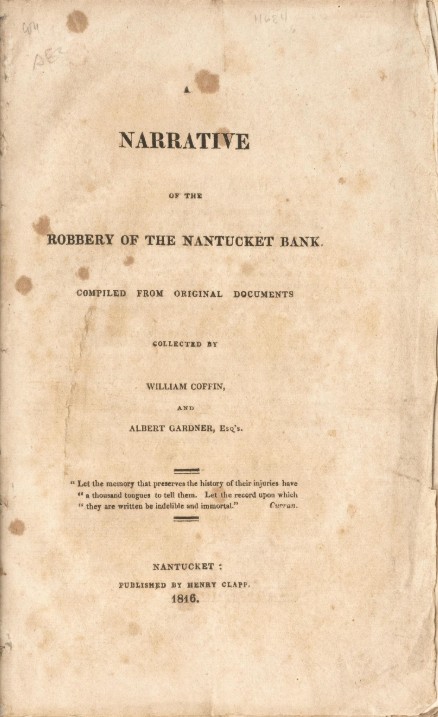
BE IT REMEMBERED, that on the twenty first day of May, A. D. 1816, and in the fortieth year of the Independence of the United States of America, Henry Clapp of the said District, has deposited in this office the title of a Book, the Right whereof he claims as Proprietor, in the words following, to wit: "A Narrative of the Robbery of the Nantucket Bank, compiled from original documents collected by William Coffin and Albert Gardner, Esq's. 'Let the memory that preserves the history of their injuries have a thousand tongues to tell them. Let the record upon which they are written be indelible and immortal.' Curran." In conformity to the Act of the Congress of the United States, entitled, "An Act for the encouragement of learning, by securing the Copies of Maps, Charts and Books, to the Authors and Proprietors of such Copies, during the Times therein mentioned:" and also to a Act entitled,"An Act supplementary to an Act entitled, "An Act for the encouragement of learning, by securing the Copies of Maps, Charts and Books, to the authors and proprietors of such Copies during the times therein mentioned; and extending the benefits thereof to the Arts of Designing, Engraving and Etching Historical, and other prints,."
tannatt & tupper, Printers.
|
|
CONTENTS *
* This page added by the transcriber. | ||||||||||||||||||||||||||||||||||||||||||||||||||||||||||||||||||||||||||||||||||||||||||||||||||||
|
PREFACE.
IN giving to the public, at this late day, a narrative of the Robbery of the Nantucket Bank, no apology will be necessary to those who are conversant with the transactions that immediately followed that event: But as many, into whose hands this work may fall, will be totally ignorant of those circumstances, the publishers deem it necessary, briefly to state them as an ample apology for what they have done. They have not wantonly torn aside the covering that time had thrown over these transactions, with a view to wound the feelings of any, nor to revive recollections that must be painful to all. But they are impelled to this measure by a sense of what they owe to themselves, their posterity and their friends. Disclaiming all motives of retaliation for the aggravated wrongs and injuries they have sustained, they lay before the public the evidence of the Robbery of the Bank, and call upon that public to pass their judgment, upon a view of the whole, and to attach the odium of the guilt upon the perpetrators of the crime.
Nantucket, May 1816. |
|
INTRODUCTION.
When it was publickly announced that the Bank was robbed, the inhabitants of Nantucket were seized with a consternation, that could not have been much exceeded had they been assured the dead had risen. A degree of horror and alarm was visible upon every countenance, and a great part of the community was agitated with apprehensions for their personal safety. The atrocity of the act, and the darkness which inveloped the whole transaction had a powerful influence upon the minds of the inhabitants, not yet familiarized with crimes, to bring into operation a talent for the marvellous, and the wonderful; and never, since the memorable times of the Salem witchcraft, did superstition and bigotry wave their sceptre over the human intellect with such unlimitted sway. If the tale of those times were rehearsed to a congregation of monks, they would smile at the absurdities connected with it: For such was the power of popular prejudice upon the minds of the inhabitants, weakened by fear, and harassed by conjecture, that every object was viewed through a distorted medium; their reason was obscured by a cloud of superstition, and, their judgment perverted by a species of epidemical madness, more de- |
It is hardly to be credited, that in this enlightened age of the world, men possessing no mean share of intellectual capacity, should resort to judicial astrology, witchcraft and exorcism as the surest method of ascertaining the perpetrators of midnight burglary. But the fact is beyond the power of contradiction, that the most implicit confidence was placed in the vague dictums of a mere remnant of mortality, assuming the gift of conjuration. This malady of the mind was as contagious as contaminating. Our old men dreamed dreams, and our young men interpreted them. Madness was mistaken for inspiration, and the ravings of a lunatic were collected into form as the basis for a criminal prosecution. Every tea – table became an Areopagus from whose decision there was no appeal; before this tribunal, the possibility of guilt constituted the crime, and the unhappy individual, who fell under its censure, was condemned without benefit of clergy. To be suspected by these Inquisitors, subjected the most respectable citizen to all the scrutiny of an inquisitorial examination. The spirit of accusation went forth at the bidding of the conjuror, and with his wand he did literally strike through the heads of this village. No one was secure who was not enlisted on the |
At length a number of respectable citizens, hunted down by conjuration, and assailed by the venom of tea – table defamation, were arraigned at the bar of their country, and publickly accused of the robbery of the Bank. With no other shield of defence than conscious innocence, and character hitherto unsullied by the breath of calumny, these unfortunate men met their accusers before a tribunal of justice. And although a storm of publick indignation was directed against them by the malignity of their persecutors, yet without a fear for the result, they awaited that decision, in which was involved the well being of every thing dear to them in life; confidently trusting, that truth would ultimately triumph over delusion, and that there would be found a preserving spirit in a court of justice that would secure them against the malice of their enemies. In this they were not mistaken. The whole combination of evidence that was exhibited against them was a tissue of abomination, of infamy and perjury, woven by subornation. It dissolved at the touch, and was dissipated by the breath of intelligent men. A |
Although this trial and acquittal were perfectly satisfactory to the minds of honourable men acquainted with the circumstances; yet the publishers are aware, that there may be some, who from want of correct information, yet retain those impressions which were early instilled into their minds. With confidence they offer them this narrative, and the accompanying documents, and only ask a careful and attentive perusal; and should their minds be untinctured by that old leven of prejudice which originated the mischiefs of which the publishers complain, they cannot doubt but there is testimony enough to produce the conviction, that no Nantucket man was concerned in the Bank robbery. It has never once been a subject of hope to the publishers, that any thing contained in this work, will purify the minds of their persecutors from that spirit of unbelief in which they have determined to persevere against every possible conviction. A combination of circumstances show, that nothing but the near approach of death, will ever extort from them the acknowledgment "I never believed any of my fellow – citizens robbed the Bank." Over such unredeemed and unregenerated depravity the voice of reason, and the force of truth have no influence; for "refutation is the food on which their folly feeds." The only security against the defamation of such is to be found in the laws of our country; and whenever any of these veterans in mischief and calumny, shall leave |
It is not the intention of the publishers to enter into a defence of those citizens of the Island, who were accused of the robbery of the Bank, nor to exhibit the black catalogue of abuses that were practised upon them, unless they are provoked to it. They only wish so to put forward this statement, that the consistency and connexion of it may be apparent, and at the same time, to show to the world, by the documents which they have collected, who the real robbers of the Bank were. Believing, by this species of negative proof, they will be enabled to remove, from respectable citizens, that opprobrium which has been industriously circulated to their injury, and to defeat the machinations of men, whose pride it is to effect to disbelieve, what, if universally credited, would be the knell of their departed popularity. This publication has long been in contemplation, and has been delayed only to obtain possession of some important documents. Through the disinterested friendship of Alex. Coffin Jr. Esq. and other gentlemen, some very unexpected information has been received, which has greatly facilitated the progress of the work. The publishers cannot sufficiently express their gratitude to Messrs * Vide 4 vol. Mass. T. Rep. I p. Coffin vs. Coffin. |
State Prison office, New-York, Jan. 20th, 1816. Dear Sir, WE have a man in the State Prison here who has given me a circumstancial account of the Robbery of the Nantucket Bank, by Witherly, Clark the younger, and Johnson; and I am perfectly convinced in my mind that this very man was also one of the gang; – He narrates most accurately the whole proceedings, beginning with Clark's sloop; taking the dollars out of the boxes and putting them into bags; the particulars of the gold coin; the making the keys for the purpose; where they proceeded with the vessel; where they divided the money; and how much fell to each man's share. I have, taken measures to get still further information on this subject. Now sir, if you and others, who had the misfortune to be implicated, are so disposed, I have no doubt but that you may have the whole matter fully developed. I shall not mention a syllable to a single soul out of this house till I hear from you. You may show this letter to whomsoever you please, but you had better keep it pretty snug till you are perfectly satisfied of what I now write. It will give me great pleasure if I can be the means of doing justice to |
Dear Sir, your friend and obedient servant, ALEX. COFFIN, Jr.
Wm. Coffin, Esq. Nantucket. State Prison Office, New York, Feb. 11, 1816. Gentlemen, I have received your letters in answer to the one I wrote to Mr. Coffin, dated 20th ult. – I have now the satisfaction of forwarding the examination, of Wm. Mc Fate voluntarily made by him respecting the Robbery of the Nantucket Bank. It is necessary for me to state, that Mc Fate gave all the information respecting this robbery, before he knew the object of our enquiry. – You will perceive that by his statement he must have been, either concerned in the robbery, or, at least, intimately acquainted with all the circumstances respecting it; for he tells us that, subsequent to the commission of the crime, he was intimately acquainted with, and, in fact, an associate of these very men, who did commit the act. I shall leave this in a day or two for Albany, on the business of this institution, and being in consequence a little hurried cannot now write you so fully as I could wish. I have however, sufficient time to say, that my mind is as perfectly convinced that those men mentioned by Mc Fate were the Robbers of the Bank, as though I had been an eye witness to the fact; – because had it not been so, he (Mc Fate) could not possibly have |
But I hope for the honor of my native town no such man, woman, or child, inhabits there. If what I have done in this business should prove the means of restoring harmony and friendship among you, it will be a most pleasing reflection to me to the end of my life; and I shall consider myself richly compensated. In obtaining this statement from Mc Fate, we have been obliged to proceed with the greatest caution, as he is a most artful fellow, and one of the most notorious rogues in America; he is an Englishman by birth, and completely versed in all the wiles and cunning of his thievish countrymen. My friend Mr. Nicholas Roome, the keeper of the State Prison, by his influence over Mc Fate, has been the means of obtaining the statement, and I very much doubt whether any other man in New York, could have obtained it. There are many curious anecdotes related by Mc Fate, in his examination, that are not mentioned in the statement, respecting the robbery, &c. In haste, your friend and obedient servant, ALEX. COFFIN, Jr.
|
examination relative to the robbery of
the nantucket bank. State Prison Office, February 14, 1816. William Mc Fate, a convict, states, that about the year 1797, he became acquainted with John Clark and his Father – the former boarding in the same house with him at a Mr. Millers, in Call Street, New York, his father boarding at Mr. William Parkers – John Clark jr. informed Mc Fate, that he and Johnson and William Witherly had robbed the Nantucket Bank of $22,000 or upwards all of which was in gold and silver – 16 pieces of which gold was apparently new, about the size of guineas. He shewed them and gave four of them to Mc Fate – The manner of robbing the Bank is as follows;. – James Witherly, John Clark, and Johnson, fixed keys a few days previous, and then left Nantucket and went after their vessel, a schooner or sloop, and returned in the middle of the night, and entered the Bank, and found themselves much at loss, when they found a padlock on the door that led to the money – they went to work in the Bank and made a key of pewter, which took them two hours, which prevented them from taking as much money as they calculated – they kept carrying it off until near day light – When getting into the vault, they found some bags hanging up in the Bank, broke open the boxes and filled the bags. The gold was put up in cartridge, in about equal amounts, and believes, that it was in boxes and not in a pot as first understood – John Clark had at first $8,000 for his share, but dont |
A man by the name of John Orsborn, was sick at the house of Witherly; and learning the money was hid in the cellar, and he being better the next day, walked out, and, the next evening, came to Witherly's cellar with a key he had made to open a large padlock, went into the cellar and took away all the money. He then bought a large elegant farm, and placed his wife on it, and then bought a handsome topsail schooner and went in her as master to Edenton, N. C. The schooner had a good freight and a number of passengers among whom was Mc Fate and John Clark – he further states he bought several vessels. – while boarding |
About 4 months after, Mc Fate left J. Clark in the West Indies, and on Mc Fates returning to Boston, he learnt that Witherly was in gaol – that he saw William Parker, who told him that he was there as a witness in favor of Randal Ryce |
Witherly broke prison at Boston, previous to his trial and came to New York, and died in this prison – Mc Fate is confident that there was no other person concerned in the robbing of the Bank than the three named above, viz. J. Clark. Jr. Witherly, and Johnson. WM. MC FEAT.
|
We the undersigned were present at the examination of the above named Wm. Mc Fate, relative to the robbery of the Nantucket Bank; the above has been copied from the original examination; read over by paragraphs to Mc Fate, who has acknowledged the whole to be correct, and has signed the same in our presence. His name in the books of the Prison is written Mc Fate.
Since the above was signed Mc Fate states that Witherly and Clark were assisted in making their escape from the Nantucket Jail by a person who was confined there for debt. When the search was made for them they were still in the Jail concealed and did not escape till the next night after the search; they bought said debtor to assist them.
The reader is requested to observe the perfect agreement of Mc Fate's statement, with the deposition of Daniel Killey, and William Parker, appendix No. 5 and 6. – And when it is recollected that these depositions were taken in 1797, and no communication ever had between Mc Fate and the deponent Killey, no doubt can remain of the correctness of the statement. – The interview between Clark, Jr. and the Quakers, and the |
How far this gentleman and his associates can justify their conduct in continuing to persecute their fellow.citizens, after they were in possession of Clark's confession, is a question for them to answer: – But surely the accused have good cause to complain of them, for keeping secret the confession of Clark, and thereby depriving them of an important defence against the accusation. We say nothing of the jesuitical finesse made use of to obtain an interview with Clark; but those who know the virulence with which this persecution was conducted, know also, that it never entered into the views of these men, to collect materials to defend the reputation of their fellow citizens from the obloquy and reproach that had been so unjustly cast upon them. * (c) Randal Rice, one the five persons indited by the grand jury, was found guilty of robbing the Bank; – but the court were so strongly impressed with the idea of his innocence, after hearing the testimony of Wm. Parker, Daniel Killey and Stevens, that they defered passing sentence. He was afterwards pardoned by the Executive, and was liberated, without ever having sentence pronounced. |
|
NARRATIVE OF THE ROBBERY.
THE Bank commenced business in the latter part of the month of May, or the early part of June, 1795, and was robbed(a) on or about the 20th of June following. When the Directors were first called together and informed by the Cashier of the robbery, he stated to them, that he first discovered it by missing some gold, – that he found all the doors locked, but recollected a trifling derangement((b)) in one of the locks that secured the entrance to the banking-room. By charter the capital stock of the Bank was $40,000 to be paid at three instalments. One instalment only had been paid; but there had been deposits to a large amount; so that, upon examination, it was found the Bank had lost about $8,000 more than all the stock-paid in. It was then agreed by the Directors,to keep secret the robbery, as a precautionary measure, to prevent any ill consequences that might arise from an immediate run upon the Bank. Persons were immediately dispatched to Boston to consult with |
At this time began that astrological pantomime, fraught with so much absurdity, folly and iniquity, which we have before described, and which, for the reasons already given, we shall pass over in silence, always reserving to ourselves the liberty to publish a full add explicit detail of every thing connected with it, whenever occasion shall require that the principal actors be held up as objects of publick indignation. It having been ascertained that several persons, who did not belong to the Island, had recently left it, Capt. Joseph Chase was appointed by the Directors a committee to proceed to Providence, and to cause them to undergo an examination. He returned without making any discovery; but he informed the Directors, that one of the judges of the Court observed to him, that "if Zeb. Wethers was on the Island at the time of the rob- |
It is necessary that we digress a little from the story of the Bank, in order to introduce to our |
John Clark, Jun. was (the son of John Clark of New Haven, a man hackneyed in vice, and a veteran in every species of iniquity. He for some time, sustained a fair reputation, and had the confidence of his fellow citizens; but having been charged with stealing a cargo of teas, the evidence in support of the charge, though not sufficient to convict him. unmasked an accomplished villain.(e) The son, with whom we have a more immediate concern, was every way worthy of his father. The old man was the instructor of his children, in his own trade, and they showed themselves apt pupils in the school of infamy. At the period of which we are speaking, Clark, Jr. was a very young man, but sufficiently skilled in his profession to set up for himself. The first knowledge we had of his practical skill in thieving was obtained from the Post Master of New Haven.(f) It was ascertained, in investigating the bank robbery, that John Clark, Jun. together with his brother Samuel Clark, John Orsborn and Johnson, stole a load of provisions from the store of Bradly and Huggins at New Haven; brought them to Nantucket and sold them. Orsborn, to prevent a legal investigation, hushed up the matter by paying for the provisions, – no doubt out of the plunder of the Bank. During the spring of 1795, Clark, Jr. was at Nantucket three times. He passed for an inhabitant of Staten Island; and the last time be cleared out his vessel from Nantucket, he is so |
Johnson, who had passed (at New Haven and New York before the robbery of the Bank) by the name of Jones, was of Stoughton, or some other town near Boston, Massachusetts. He was once a convict on Castle William, from which he made his escape. He had for some time been associated with old John Clark, in his nefarious trade; and was a bird of the same feather. Witherly was a native of Rhode-Island; his real name was Zeb. Wethers; but for accommodation, he assumed any name that would answer his purposes, and used it during pleasure. He was convicted of a burglary in Newport, and sentenced to be publicly whipped at the corners of the streets. The sentence was executed,* and he soon left Newport for New-Haven, where be took the name of Wm. Sandford. In the spring of 1795 he and Johnson stole a cargo of hemp from Comfort Sands out of a store in Brookline; carried it to New-London and sold it to one Tilly, a ropemaker. Tilly gave them a bill at time upon E. & Wm. Coit, New-York. This bill was after some time presented for payment; but Tilly having informed the Messrs. Coits, that he suspected the hemp was stolen, they wrote upon the bill, "that acceptance was refused, because the bill was drawn for payment of stolen property." Tilly got his hemp for nothing, and Sands refused to meddle in the affair, alledging as * This information was obtained from Judge Sherben of Newport. |
* This information was obtained verbally from Mr. Tilly of New-London, and is stated as nearly as could be recollected. |
To ascertain the truth of this story Pond accompanied them to New-York. This was about the 8th of August 1795.(h) He there found Witherly in Bridewell and was about to commence a prosecution against him for breaking his store; but was dissuaded from doing it by Alderman Beckman. The Alderman assigning as a reason why he should not prosecute, "that Witherly was about to discover a set of counterfeiters, and one in particular, who had a large quantity of counterfeit money of the New-London Bank." Witherly did afterwards name a person, according to his promise; but no such person, as he named, was to be found. Pond reluctantly gave up his intention of prosecuting Witherly, and compromised with him for a bill of sale of the sloop and $500. Witherly conveyed the vessel to Pond by a bill of sale which he signed |
The next account of Witherly, Johnson and Clark is at New-York, on the 13th of June, from whence they cleared out the sloop Dolphin purported to be owned and commanded by John Orsborn of Sagatuck, Connecticut, and bound for Nantucket, where she arrived on the 17th June, 1795, and left on the 20th at night.(h) John Clark, Jr. went to the custom-house to enter the sloop Dolphin. The collector having recently seen him, immediately recognized him; and observing, by the vessel's papers, that John Orsborn was master, enquired why the captain did not come himself, and enter his vessel. Clark informed the collector, that the captain was seized with the small pox, and they had, in consequence of it, landed him on Long-Island. On examining the manifest, it appeared that Clark had signed John Orsborn's name to it in New-York. The shipper, per manifest, was George Jones, a name that Johnson had assumed in the affair of the hemp with Tilly; and the consignee was James Smith one of the numerous names that Witherly had taken upon himself. So that, in fact, John Clark, Jr. was the master of the sloop Dolphin, Johnson the shipper, and Witherly the consignee; all of them on board the Dolphin, at Nantucket, on the 20th June 1795, under fictitious names. By the manifest, flour, bacon and corn were cleared out at New-York; but, * This information was obtained from Capt. Pond in 1795, and is, as nearly as can be recollected, verbatim, as he related it himself. |
When the news was received at Nantucket, that a man, charged with the robbery of the Nantucket Bank, had been apprehended in Philadelphia, enquiry was made to ascertain, what vessels were at Nantucket at the time of the robbery. It was then the particulars above related were obtained. It was afterwards ascertained, beyond a doubt, that the story of Orsborns having the small pox was a fabrication. A Mr. Jessop, and other respectable gentlemen of Sagatuck, neighbours to Osborn, knew. that he went to New-York in the Dolphin, returned home without his vessel, and declared that he had chartered her out In about two weeks after that, he again went to New-York, returned with his vessel, stripped her, and she lay unemployed a number of weeks. During all this time Orsborn had plenty of cash, to the great surprise, of his neighbours who were acquainted with his circumstances, and knew them to be indigent. The summer before he had been employed in fishing, and had made a bad voyage; had been in no way since to recruit his finances – |
On receiving intelligence from Philadelphia of the arrest of Witherly, many of the directors advised to send some person there, with a view of examining him; but a majority of them were opposed to this measure: for unfortunately for the peace of the community, the symptoms of the malady that afterwards so severely afflicted them began to ap- |
William Coffin about this time received(l) a letter from the post master of New-Haven touching the character of John Clark, Jr. together with an advertisement of beef, pork and other articles supposed to have been stolen by Clark and his gang, and sold at Nantucket. Mr. Coffin immediately laid the letter from Mr. Beers, and the advertisement of Bradley and Huggins before the president and directors of the bank: informing them, at the same time, of his having found some of the provisions described in the advertisement of Bradley and Huggins. The circumstances were so strong against Clark and his gang, as to excite a |
|
About this time intelligence was received that Johnson was, a second time, arrested in Philadelphia, and that one Phelps(n) and McDonald were the witnesses against him. In consequence of this information, Joseph Chase was dispatched to Philadelphia as an agent for the Bank. William Coffin and Josiah Barker, Jr. accompanied him at their own expense. On their arrival in. Philadelphia, they found Johnson had broke jail and made his escape. One William Parker, who had been charged as an accomplice with Johnson, was then in confinement. He had been examined, previous to his commitment, before chief justice McKean (o) He was, at the request of Mr. Chase, and the other gentlemen, brought before Alderman Baker, and there underwent a further examination. In the course of which, he stated that Witherly informed him and John Orsborn, that the money, they took from Cow-bay, had been stolen from out of the Nantucket Bank, by himself, Johnson and John Clark, Jr. That little Jack, meaning John Clark, Jr. had gotten his share of the money, and that what they then had on board the vessel belonged to himself and Johnson. But that he should keep Johnson's part, because he owed him for board, and had broken open his trunk some time past. Parker was liberated from prison upon giving bonds for his appearance before the supreme judicial court of Massachusetts; where he did appear, and was examined touching the guilt of Clark, Johnson and Witherly. |
While Messrs. Chase, Coffin and Barker were in Philadelphia, they received information that Witherly was in New-York. Coffin took an officer, who was acquainted with the person of Witherly, and went on to New-York to apprehend him. At New-York they learned Witherly was on Long, Island – there they followed him; but he eluded their pursuit, and finally escaped them. Chase on his return to Nantucket, heard that Witherly was at New-Haven. He watched for him there, and took him in the night, as he was on the point of embarking for the West-Indies. Witherly was armed, when taken, and had with him about fifty guineas, which a Mr. Shipman of New-Haven obtained as indemnity for a former theft committed by Witherly and his associates.* Mr. Chase brought Witherly, in irons, to Nantucket, and, at that time, professed himself fully of the belief that Witherly, Clark and Johnson were the robbers of the Bank. Mr. Chase declared that he could have obtained from Witherly, (upon condition of releasing him) remuneration for his own private loss of the money stolen from the Bank. When Witherly was brought, in irons, to Nantucket, he was delivered into the custody of the Bank directors. They had the entire charge of him, and kept him in a very singular manner. No complaint was made, no accusation was set up, and no legal proceedings were had against him. He was confined in the chamber of a dwelling house, and none, but the directors, permitted to have access * This is according to the representations of Mr. Chase. |
After Witherly was committed to prison the directors furnished a guard day and night. This was in the spring of 1796. Immediately after this Mr. Joseph Chase went to New-York, arrested John Clark, Jr. and brought him to Nantucket. Clark was examined in New-York before a magistrate of that city, and was again examined at Nantucket. Among other things he confessed that he carried off in his vessel the money that Johnson and Witherly stole from the bank, and related many of the minute circumstances connected with the robbery. This examination is not now in the possession of the publishers. Should it be seasonably obtained, it will be inserted with the other documents. John Orsborn was arrested on or about the time Witherly was taken up at New-Haven, and gave bail(q) for his appearance at the trial. Some time in April 1796, John Clark, Jr. was committed to an apartment of the same prison in |
|
In the summer of 1797, Albert Gardner applied to Mr. Sullivan, then attorney general of the state of Massachusetts, for assistance in apprehending those whom he considered the Bank robbers; and requested to be advised of the most practicable method to secure them when taken, so |
The grand jury for the counties of Suffolk and Nantucket was dismissed, and no complaint having been made to them against Witherly, no trial could be had that term. He was however brought up to the bar for examination. The court examined Daniel Killey, Wm. Parker and Stevens, the witnesses against him, and finding such strong proofs of his guilt, they remanded him to prison to take his trial at the next term of the court. Before that time he broke jail, and the next news we had of him, was in the state prison, New-York, where he died, agreeable to McFate's statement. We have before said, and we again repeat it, that we believe there is no one, who candidly and attentively peruses this narrative, and the documents subjoined, but will be convinced that John Clark, Jr. Zebulon Witherly, and Johnson, were the only ones concerned in the robbery of the Bank: and to many it will be unaccountable how a contrary opinion could ever have prevailed. It is not within the scope of our intentions to assign all the causes that produced this opinion, and gave it |
We have given a concise narrative of the robbery of the Bank, and of the attempts at discovering those who were concerned in it: and have merely hinted at the persecution and oppression of a number of respectable citizens; suppressing (for the reasons already given) a detail of tho malignity of that persecution. It was our intention originally to disconnect the accusations of citizens of the island, with this publication; but the circumstances attending that prosecution were so interwoven with the whole transaction, that it would have been impossible to have disconnected them, and have preserved any degree of consistency throughout the whole. From a perusal of the narrative it will he seen, that well grounded suspicions were entertained against Clark and his companions immediately after the robbery was discovered. The sudden departure of the sloop in which they came to the island, and the doubtful character they sustained there, created these suspicions, and the subsequent arrest of Witherly in Philadelphia confirmed all reflecting men in their belief, that Clark and his gang robbed the Bank. This question would very naturally occur: – Why were not these men pursued, apprehended, and brought to trial before they had opportunity to use or secrete the money, and thus destroy the most conclusive evidence of |
After accusing these gentlemen, and subjecting them to the ignominy and disgrace that attaches itself even to suspicion of guilt, it became necessary for the abettors and promoters of the accusation to persevere in it, in order to ward off a scrutiny into the chicanery they had practised through every stage of it. A trial of Witherly and Clark, Jr. would most unquestionably have convicted them of the robbery – it was necessary therefore, to prevent, (if possible) a trial to be had upon Witherly and Clark to screen themselves from censure, and to forward their ulterior operations' against the accused. This construction of the con- |
|
FINIS.
|
COPY.
Philadelphia, 8 mo. 11th, 1795.
My Dear Friend. }Peleg Coffin, Jr. } Since I wrote thee on the 8th instant, I have received thy letter which I communicated to the Mayor; he appeared confident the person committed by him, was one of the persons described by thee. I think it was Smith. He said it was then asserted his name was Wethers, but was committed to jail in the name of William Sandford. Friend Clarkson refered me to Judge Shippen, the judge before whom the person had a hearing, on a writ of habeas corpus, and discharged. On my calling on Judge Shippen, he informed me the person alluded to was committed on the charge of suspicion of being engaged in robbing a store in this city, and there was no suspicion mentioned in his commitment of being concerned in the robbery of the Nantucket Bank. Though the Mayor had made a suggestion of some suspicion, he thought proper to order his discharge, on giving security for his good conduct; although suspicious, nothing offered to criminate him – but did not think proper that he should be let loose on the public without security. On sending to the jail I find he was discharged near three weeks since. I called on the Mayor after seeing Judge Shippen. With him I left the letter, and expect he will be vigilant in having enquiry made after the persons generally. It is hardly probable the person, that was committed by the Mayor, is yet in this city. I am, &c. GEO: PANNOCK.
|
|
|
On the Sunday following my wife made Weather's wife a visit, who made her a present of one hundred dollars in silver, tied up in my pocket handkerchief; but my wife could not carry it as she had her child to carry home; but in a few days, my wife went and got it, or Weathers' wife brought it to her, I do not know which. The deponent says Weatherly carried new bags to put the money in, and when it was taken out of the sand, the old bags were all rotten. And I at the request of James Weatherly, when he was confined in jail in New-York, took a certain William Hewit, otherwise Doaty, to where Wetherly told him there were two bags of money hid under some grass on the shore; they could not find them. Signed) Wm. PARKER.
Taken before me, the 10th day of December, 1795. Thos. McKean, Justice.
|
New.York, 8mo. 13th, 1795.
Esteemed Friend, } We received thy favour under date of the first ult. and thoroughly noticed its contents and have every reason to believe that your surmises are founded with justness, and are of the same opinion with you, relative to the robbery, as John Clark and his associates are undoubtedly employed much in that kind of business, and from the circumstances detailed in thine, we are almost without a doubt on the subject, and if we can be any way serviceable to you in detecting the villains, the which we shall endeavour to do, we shall be glad to do it, but shall not take a farthing for our trouble, being always glad to be serviceable to our friends, who we esteem the people of your Island to be. But from the tried abilities of this Clark, in the business of robbery, we are too fearful he will elude the most diligent watching, having lately freed himself from our prison, notwithstanding we presume there is not a person here of reputation who does not believe that he was guilty of all the facts alledged against him. Yet he worked the matter in such a skilful manner as to prove himself clear, and threatens to prosecute those that imprisoned him for false imprisonment. But it is possible his friends may have him unguarded, at some time or other, so that he may be detected. We are respectfully, &c. ALSOP & HICKS.
|
(f) Copy of a letter from Elias Beers, Post Master at New-Haven, to Wm. Coffin, Post Master at Nantucket. New-Haven, Oct. 13, 1795.
SIR, Your favour of the 27th ult. came duly to hand; with pleasure I will assist you in the important business of endeavouring to discover the authors of yours, as well as others, calamity. John Clark, Jr. (the person you mention as being at Nantucket repeatedly, in the course of last spring, and summer) has been, for some time, strongly suspected, by many of the inhabitants of this town, as several stores have been broken open, and property to a considerable amount taken out. In particular, last spring, a store in this town was robbed of about 20 bbls. of Pork, 20 kegs of Lard, and a quantity of Hams. As it is probable said Clark was concerned in this robbery, it would be well to enquire of those persons who purchased pork, &c. of him, if any of the barrels can be found, either in families or on board of vessels; the mark (if any) may be taken off, and forwarded here, though it is probable he has had the precaution of dubbing out the marks, as has been the case of some kegs of lard that is suspected to have passed through his hands. Said Clark never was an inhabitant of Staten-Island, but born and brought up in this town. There are a number of circumstances, which give strong suspicions that he was concerned in the robbery of your Bank. Some persons from this quarter were at Boston, last summer in a vessel, and |
Sir, your obedient servant,
ELIAS BEERS.
Attached to the foregoing letter was an advertisement of the articles stolen from Bradley and |
(g) The letters of Old John Clark to his son Samuel. – These letters are published with a view of showing the character of the gang concerned in the bank robbery, of whom Old Clark was the leader. Perhaps there never was a set of thieves, in the United States, that conducted their business upon a larger scale, or better calculated to carry it on to perfection. These letters were written while Old Clark was in prison, upon a charge of stealing a cargo of Tea, and with some corrections in the orthography, are a correct copy of the originals, which were found upon Samuel Clark by Elias Shipman, a respectable merchant of New-Haven. No. 1.
Capt. Samuel Clark – I want you, if Thomson has come back, to get a bill made out for those goods, as I have described to you, with an addition of one piece of dark cassimere that cost 12s. per yard, 87 yards, and get it receipted as a common bill of goods paid last October by me. The person must say, if ever called on, that he did sell the amount and goods; but I believe they never will be, if it is any person known to sell goods in New-York. You must also find how many boxes of Tea Jones has had of me; and how many William Edgar claims? And how many James and Gilbert Woodhill have? And how many Wil- |
After you have completed this business and entered all those matters in a sale book kept for that purpose, as I told you before to do, burn this paper. Let nothing appear in my hand-writing; let nothing frighten you in what they can say. Tell them all, you know nothing; only that my mind is in perfect ease to the charges laid to me. I am your honoured Father,
JOHN CLARK.
Post. You forgot half the business I sent to you before. I did not want the testimony now; only to see if they would swear to that if I wanted, some time hence; or any other person that was a hand on board at that time, when the Tea was delivered here. I am afraid you neglect me for other trifles. You never sent me word in your letter what Capt. Ward's answer was to mine. You must consider and be attentive to me, for I did not forget you in the worst of difficulties, and in worst of dangers I saved the sloop for you. |
Find out if you can if Mr. Edgar has not sold the ship America's cargo of hyson, of ninety-two. Get Mr. Lacy and others to let you know if possible. He says they have not sold any of that cargo. No. 2.
Capt. Samuel – You must call on Baldwin and bring the copy of my first attachment of Wm. Edgar; it will be wanted here – I want to shew it. Call on Mr. Daggett for the money for the note which is $180 due, and likewise make your demand for the Tea, if Olmstead will do it. From your friend and humble servant,
JOHN CLARK.
Post. Get the money for the goods as fast as you can. No. 3.
Captain Samuel – You must exert yourself for me now, by going to Miss Dalton's in Cherry-street, and seeing if you can find Wm. Thomson, who, (if there) will do all he can to get me clear. If he should not be at home, you may tell Miss Dalton that I am confined for twenty thousand dollars, and get her little boy to shew you where Weatherly is. It may be he was a hand on board and will assist me, by telling him you have come on my business, and that you are my son. Yon must not let any person know your business, only those I direct yon to call on. Be sure if they are the persons, before you disclose the matter, or deliver the letter to Miss Dalton which I send by you. Either of those persons will inform you con- |
Your honoured Father,
JOHN CLARK.
No. 4.
Captain Sazmuel – Get the bill if possible this time for the goods mentioned; and on my part tell Mr. Israel no person shall know it till the last moment. I believe I shall settle with the Quaker by leaving the matter to men here, at she eleventh hour. He may depend on secrecy, on my part. The goods are more in price than what he has stated. – The blue cloth cost 16s. and 6d. sterling, and the cassimere 5s. and 9d. sterling; and thicksett cost about what he has set it at – – 4 pieces of calico cost 2s. and 8d. sterling. There must he an allowance for charges on those goods as much as 20 per cent. more. 'If you can see Thomson do, and tell him my situation. He must send me a bill of sale of the sloop, if he makes it from his own hand – writing. I am sure he must know I do not |
I am yours, &c.
JOHN CLARK. No. 5.
New-York, Nov. 25th 1794.
Capt. Samuel – I have wrote you two letters, one for my wife, and one for David Daggett, Esq. which you will deliver to him. If Olmstead is there you must make a demand for the Teas, and he must declare to the bill sold you last March, |
From your affectionate father,
JOHN CLARK. No. 6.
Samuel – I want the account of sales from Mr. Timothy Atwates, of March 10th, 1793, of ten chests, and all the rest since the date. As they have got my book, I cannot tell all that A. Bradley has had. Likewise how many he has sold for me. I want to know whether they had seen Lent Hotchkess' box – let me know. You must get a receipt in full from J. and Stevans for Tea sold, 91 chests. The bill I mentioned before, if possible. Stevens knows I settled with him, in full, when he went away with his sloop. You may tell Thomson people all know it here. The first moment they took me, this order and every thing else was known. I wish them out of prison, to help me if they will, as they know I am worst off. They must send a bill of sale for the sloop, or else she will go the same way. That must be done immediately, Mind, to do this, if possible, and if I am carried to New-York, you must see me with Mr. Thomson, my attorney. I shall want some thing, likely done. |
You must do all you can now. Let no person see this, only yourself. Your humble servant,
JOHN CLARK. Post. You must mind to enter and clear the vessel if you have any freight; or else they will get hold of you. If you have any more than the law allows, and if not make out your manifest and carry it with you as soon as you sail, this is the law now. I also send two letters, one to Davol. I want his answer, if there is any persons will do any thing. I must know soon of Mr. Woodhull if he does not know having sundry chests of Tea, marked Ship Nancy, and other marks, they could not claim from me, and will give testimony for the same. No. 7.
Capt. John Ward – Dear Sir, I beg of you as a friend, not to mention any thing about the business, taking Tea in New-York; for there was only nine chests, and I suppose they were smuggled on board. I believe you really thought so yourself. For God's sake, do not you be the means of adding more affliction on me than what I have got. If you thought I was guilty of stealing, why did you not warn me of the same at the time? I beg you will not now, in this time, when I cannot help myself. I hope captain, you do not harbor any thought that I was ever guilty of taking a farthing from any man wrongfully. I fully believe you think so, and would tell the world so, if you was to do me justice. Did I ever keep any thing in private from |
I am yours,
JOHN CLARK. Post. Capt. Ward when you return, come and see me. You may at a distance. No. 8.
Captain Samuel – Read these lines to captain Ward in private, and destroy the letter afterwards; for they will get hold of every straw. Go on steady, and find the minds: of every person. Ask Potter if he did not help about the Tea, being landed here, when in Bucher's room. Find the talk out of, every person in York. It may be of service to me; but say nothing yourself to no one, only where I direct you. Mark all what is said, write all in a small book, how many boxes they find in York, of those marks that I have sold, and of every thing else. No. 9.
Samuel – I want Mr. Olmstead to go with you, to declare to a bit of the Tea sold you last March. Apply to David Daggett, Esq. to get clear in your name. Olmstead has nothing to do only to swear |
No. 10.
Capt. Samuel – You must call on John Cozine, Esq. and know of him if I must come to Court the 24th of this month, without fail: for I have a suit depending at Hartford that I want to be there the 25th of this month. Call on Parker and tell him to inform Weatherly that two fellows have done me all the injury they could; for they not only made use of my name, but told it to Edwards, that I was in such a situation myself, that I could do nothing with Pond;* and he has told that I was concerned in the fact myself, and was able to prove it. Damn such Rascals for being sent to do business, only to enquire of me. I will bring them up and let them know better. Tell Weatherly or Parker that they ,must stand ready to clear themselves. From yours,
JOHN CLARK. (h) See Note (d). (i) Testimony of John Clark, Jr. of lawful age, deposeth and saith that I have known my father to keep Tea to sell ever since he built the store on the Wharf. And in the year 1791 some time in * This refers to the affair of the Sloop, at Milford River, and the two men Pond apprehended on suspicion of having a concern in robbing his store. |
JOHN CLARK, Jr.
Questions by Mr. Edwards – Is the body of this deposition in your own hand writing. Answer – Yes. Q. Were you not at Nantucket in the month of May last? A. Yes, I was there in the month of March or April. |
Q. What vessel were you in and who was Master of her? A. The sloop Sally, John Clark, master. Q. Who owned the said sloop Sally? A. She belonged to me the Deponent. Q. What was her burthen? Nineteen Tons and 3.4. Q. Where was she built? A. At New-Haven. Q. Who built her? A. Wm. Woods. Q. Was it the same sloop one Stephens used to sail? A. Yes. Q. From whom did you purchase her? A. From my Father. Q. From whom did your Father buy her? A. I can't tell. Q. To whom did you sell her? A. To Abraham Wilson, New-York. Q. And what price did you sell her? A. $500. Q. Did he pay you cash in hand? A. No. Q. How did he pay the $500? A. I took a Note for it on interest. Q. Was that note taken in your own name or in the name of your Father? A. In my own name. Q. Did not you sell that note to your Father? A. No, I gave it to my Father to collect for me. |
Q. When you went to Nantucket in said sloop, where did you take in your cargo? A. At Norwalk I took in a cargo on freight. Q. What was the cargo? A. Some Beef and some Pork – 10 of beef and 8 of pork. Was that the whole of your cargo? A. Yes. Q. For whom did you carry that freight? A. For James Miller of New-York. Q. Where in New-York does James Miller belong? A. I am not able to say – he lived when I returned in Prince-street. Q. Out of what store was the freight delivered you at Norwalk? A. Out of a vessel. Q. Where at Norwalk did that vessel lay where you took in said freight, and who was master of her? A. Down at the mouth of the Harbour, and James Miller was master of her then. Q. Why did they deliver the freight at the mouth of the harbour? A. They were going up to town to take in a load of grain. Q. What sort of a vessel was the one out of which you took Miller's said freight? A. She was a sloop, called the Maria of New-York 24 or 25 tons. Q. Where did you see Miller make an agreement with him to take his freight? |
A. At Norwalk when I was lying at anchor on my way to New-York. Miller came on board and agreed about the freight. Q. How many hands had you on board at the time you took in that freight and went to Nantucket, and what were their names, and where did they belong? A. Two men; their names were John Orsborn, and one Orsborn his brother, whose Christian name I don't know; they belonged to Long-Island, Richmond County, I believe. Q. Did you carry all the freight you took in to Nantucket? Yes. Q. To whom did you sell it at Nantucket? I don't recollect,the people's names. I retailed out the beef and pork to several people. Q. Was the cargo you carried consigned to you? A. Yes. Q. Did you receive the pay for it? A. Yes, chiefly. Q. Who received any part of the pay besides you? A. John Orsborn. Q. How much did he said Orsborn receive? A. I cannot tell. Q. Have you not seen Orsborn since that voyage? A. Yes. Q. Was there not a box which appeared to |
A. No. Q. Were you not at Nantucket in May? A. No. Q. Were you not there in a small schooner in May? A. I was not there in May that I recollect. Q. Were you not there between March and June in a small schooner from Staten Island. A. Yes, I was there in June in a small schooner from Staten Island. Q. What cargo had you on board that schooner at the time you was there in her? A. We had corn and flour; I was only pilot of her. Q. Who was master of her? A. Samuel Smith of Jersey. Q. What other people were in the vessel with you at that time beside said Smith, and where did they belong, and what were their names? A. One belonged to Staten-Island; his name was Peter Morris, beside the master and myself. Q. What was the schooner's name and who owned her? A. She was named the Rover, I don't know who owned her. Q. Where did you take in your cargo? A. I don't know. Q. Where did you first go on board her? A. At New-York. Q. Had you any acquaintance with the said |
A. Not much. I saw him a few days in New-York before we went. Q. Did you carry any thing but grain and flour that time? A. No, not that I know of. Q. What sort of grain was it? A. Corn. Q. Did you sell any part of the cargo at that time? A. I sold a part of the corn at that time to whom, I dont't know. I never gave any bill of it nor receipt for payment. Q. Have you been at Nantucket since you were there with Samuel Smith in said schooner? A. No. Q. Were you not there in June in sloop Dolphin? A. No. Q. Did not you in the month of June last at Nantucket sell a quantity of; corn to one Mr. Barker, and give him a bill of it and a receipt, out of sloop Dolphin? A. No. Q. Did you not on the 20th June last clear out the sloop Dolphin from Nantucket as master? A. I don't recollect as I did. Q. Were you not in the month of June or July last at Nantucket in the sloop Dolphin? A. I was there in July, I believe some time about the middle of July in the sloop Dolphin. |
What did you carry? A. Corn. Q. Were you master of the sloop? A. Yes. Q. Where was she owned and by whom? A. She was owned by men alone. Q. Who did you buy her off? A. I took her in New-York, but don't know of whom. Q. Did you carry no other cargo but corn? A. No. Q. Where did you take in your cargo? A. In New-York. Q. Where did you clear out from? A. New-York. Q. In whose name was the vessel cleared out? A. In John Orsborn. Q. Where was he taken sick and where did you leave him? A. He was taken sick on the passage, and I left him at New-London. Q. What other persons were there on board the Dolphin at that time? A. One man. Q. Who was he and where did he belong? A. His name was Peter. I don't know where he belonged. Q. What kind of a man was Peter in point of stature? A. He was a tall man. Q. What has become of the Dolphin? |
A. She is sold to John Orsborn – at least she always belonged to him, but I took her in my name. Q. Where does this John Orsborn usually reside and where does he reside now? A. I don't know, I have not seen him since I came from sea. Q. When you left Nantucket, where did you go? A. To New-York. Q. Did you carry any cargo from Nantucket? A. No. Q. Who owned the cargo you carried to Nantucket in the Dolphin? A. It belonged to Orsborn chiefly. I owned a small part of it. Q. Was John Orsborn ever at Nantucket.with you at any time only when you sold the Beef and Pork? A. No. Q. Are you certain you was not at Nantucket in the Dolphin in June last? A. I am not positive. State of Connecticut, as. } Then personally appeared before me the Subscriber, Judge of the County Court of New-Haven and Mayor of New-Haven, John Clark, Jr. and made solemn oath that the foregoing deposition by him signed, and the foregoing answers by him given to the foregoing questions proposed by Pierpoint Edwards, Esq, as attorney to Thos. Eddy, the adverse party contain the truth, the whole truth, and |
SAMUEL BISHOP.
The foregoing is a true copy of the original deposition and of the questions and answers thereunto annexed and forming a part of the same. Examined and certified by SAMUEL BISHOP, Judge and
Mayor as aforesaid. (from the Original.)
(k) See Note (c). (l) Sec Note (f). (m) See Note (i). (n) November 30th, 1795, Barzaliel Phelps of Second Street, No. 206, swears, that Samuel Johnson, told him, one evening last week, at the house of Philip Waggoner, in Front Street North, No. 252, sign of the Golden Eagle, that he was one concerned in robbing the Bank at Nantucket, that he was cheated out of his full share, having only received $2200 dollars; that his full share would have been $7000. That capt. Weatherly took the Taylor with him when he went after the money, and drove him (Johnson) off, with pistols. That the money was concealed on an island, don't recollect what island; that the Taylor above alluded to, he hath found since that his name is Parker, and that he lives in George Street, New-York. (Signed) BARZALIEL PHELPS.
Sworn before Matthew Clarkson, Mayor.
|
(Signed)
BARZALIEL PHELPS. Matthew Clarkson, Mayor. (o) See Note (d). (p) COPY. City Of New-York, ss. Wm. Doty, of the City of New-York, cordwainer, being sworn, saith, the time James Witherly was confined in the jail at Nantucket, ––––, with one and sometimes with two men called on this deponent, and informed this deponent that he came on Witherly's business to procure as many affidavits, in favour of said Weatherly as possible and at the same time persuaded the deponent to make |
(Signed) &Wm. DOTY.
Sworn to 20th April, 1797, before Theophilus Beckman, Alderman. Note –
(q) COPY. Nathan Olmsted and John Orsborn' Bond taken by Joseph Chase after he had taken up Witherly at New-Haven. Know all men by these presents, that we the Subscribers, Nathan Olmsted and John Orsborn, both of Norwalk in the county of Fairfield and |
The condition of the above Bond is such that whereas on the twentieth of June last past, there was deposited in a certain store, and the vaults of said store belonging to Nantucket Bank, known by the name of the President, Directors and Company of Nantucket Bank, which Bank was in the town and county of Nantucket in said commonwealth, more than twenty thousand dollars, and whereas some persons did on or about the said 20th June, feloniously in the night season break into said store or vault, and did steal and carry away out of said bank and said vault more than twenty thousand dollars, and whereas that Wm. Parker, John Clark, Jr. James Weatherly and others are supposed to be the authors of, and concerned in, said felony, and whereas said Weatherly is already taken and now confined for trial for said felony, and said Parker has given bail for his appearance before the proper court in said commonwealth for trial, as being an accessary in said felony; and whereas the said John Orsborn is a material witness and can testisfy to material facts respecting said felony. Now therefore, if the said John Orsborn shall at any time hereafter appear at a proper court which shall |
Signed and sealed by NATHAN OLMSTED, JOHN ORSBORN.Sealed and delivered in presence of Joseph Noyes and Lewis B. Sturges. (r.) COPY. I, Daniel Killy, of Nantucket, of lawful age, do testify and declare, That on or about the twenty second of April, in the year 1796, I was appointed as a guard in the jail yard, to take care of one Zeb. Withers, alias Wetherly, alias Sandford, alias Smith, who had been committed to jail on the charge of robbing the Nantucket Bank. That I continued as a guard every other day until about the middle of May; I, likewise was on guard several nights. That soon after I began to watch, Withers began to intercede with me to let him escape from jail, I told him I would not listen to his proposals, except he would make a full discovery |
|
I being requested by one of the directors of the Bank to get all the knowledge I could out of him concerning the robbery, I was induced to listen to his conversation. He likewise told me he had hired –– –– to go to New-York, to get him some money, and to got some depositions to prove that he was at New-York at the time the Bank was robbed, but that if such evidence was procured it would be of no consequence; that he was to give him one hundred dollars for his service in going to New-York aforesaid. I still insisted that there was some Nantucket men concerned with them in the robbery, and that Rice's handkerchief |
(Signed) DANIEL KILLY.
Nantucket, April 27, 1797. Question by Randal Rice. Did Withers tell you that he lighted a candle in the Bank? Answer. Yes, he did. Question by same. In what part of the house did he say they lit it? Answer. He said it was in a bye place at the left hand as they went into the Bank. |
Question by same. Did you know of any such closet in the Bank at that time? Answer. Answer. No I did not. Question by same. Did you ever endeavour to find whether Withers had any acquaintance with me? Answer. Yes, I asked him if he knew you, and he said he did not. Question by Walter Folger by Sylvanus Macy. Had thee Witherly's clothes at thy house? Answer. Yes, I had. Question by same. What time was it thee had his clothes? Answer. I cannot exactly tell, but about 12-clock. I don't know the day. Question by same. Did Witherly call on thee in presence of John Gardner, Esq. and say to thee that he had told thee there was six Nantucket men concerned in the robbery of the Bank, and he had told thee there was four, and he had told thee there was two, and he had told thee there was ne'er a one? Answer. No, he never did. Question by same. Did John Clark ever pass down a handkerchief that was pinned or tied up to thee, and did thee pass it to Witherly without examining it? Answer. No, I never passed any thing to either of them, except a book, in my life. Question by same. Did thou go to the jail yard after thou was discharged by the Directors, |
Answer. No, I never did. Question by same. Did Witherly get his clothes from thee before thee was discharged or after? Answer. It was afterwards. Question by same. How long had thee Witherly's clothes in possession? Answer. About two or three weeks. Question by same. What motive had thee for keeping his clothes? Answer. He wanted me to take them and air them for him. Question by same. "Did thee ever wear any of Witherly's clothes while they were in thy possession? Answer. No, I never did. (Signed) D. KILLY.
Nantucket, ss. April 27, 1797. Then personally appeared before me the Subscriber, one of the Justices of the Peace within and for the County of Nantucket, the within named Daniel Killy. And after being duly cautioned to testify the whole truth and nothing but the truth, made solemn oath to the truth of the within written deposition by him subscribed. Taken at the request of Randal Rice of Falmouth, in the County of Barnstable, trader. To be made use of in an action of the case, to be heard and tried at the Supreme Judicial Court to be holden at Barnstable, in and for the County of Barnstable, on the second |
Wm. HAMMATT, Justice Peace.
May term at Barnstable 1797, opened in court and filed. JOHN TUCKER, Clk. (s) Boston, June 10. Mr. Albert Gardner of Nantucket is on his way to New-York and Philadelphia, in pursuit of James Weatherly, Seth Johnson and John Clark, who have been charged on suspicion of having robbed the Nantucket Bank, and who have escaped from confinement. The said Gardner having made application to me as Attorney General of the State of Massachusetts for advice and support, I hereby solicit for him the aid and countenance of the magistrates and officers of the peace in the several States where he may be and can; with respect to them, and good wishes for his success. JAMES SULLIVAN.
Mr. Gardner proceeded on to New-York and took up Witherly and forwarded him on to Nantucket, from thence he was sent to Boston. Boston, Aug. 1, 1797.
One Witherly is in jail in this town under a charge of felony in robbing the Bank at Nantucket, |
I have the honor to be, with great respect, JAMES SULLIVAN.
Should any other witness be discovered who appears to be material, I wish him to be treated in the same manner. Mayor of the City of New-Haven. (t) See Note (p)The depositions of Mary Morris and Leveret Stephens will tend to confirm the depositions of Daniel Killey Wm. Parker and others, as respects John Clark, Jr. his having received his part of the plunder of the Bank, and landing with the same at New-Haven, previous to Johnson and Wither's deposit on Captain's Island. |
Benfield's deposition further tends to strengthen Parker's deposition or confession, respecting the Bank money being deposited on Captain's Island. As respects the deposition of John Clark, the father of John Clark, Jr. inserted only because it is found among the papers of the narrators; but at whose request it was taken, they do not now recollect, and all the weight they give to it is such? as it may be confirmed by other evidence. COPY.
Deposition of Mary Morris, wife of John Morris of New-Haven, in New-Haven County, of lawful age is as followeth: That on or about the 7th day of September, in the year one thousand seven hundred and ninety five, the wife of Captain John Clark of New-Haven, sent for this deponent, requesting her to go and see Mrs. Clark, whereupon this deponent went to Captain Clark's house, and there Mrs. Clark, wife of the said Captain John Clark, informed this deponent, that she had a secret which she wished to communicate to her the deponent, and after some time spent in conversation, generally on the subject, the said Mrs. Clark told this deponent, that she the said Mrs. Clark, was very uneasy that Captain Clark and his son John were all night before gone out in a boat, and that they the said Captain Clark and son that morning had a chest or box in the barn, and had taken up the barn floor, dug a hole and buried the chest or box, and |
|
Question by Mr. Barker. Had you heard that the Nantucket Bank had been robbed previous to Mr. Clark sending for you? Answer. Yes. Question by same. Was you ever at John Clark's when Mrs. Orsborn, wife of John Orsborn, was there? Answer. Yes, I was there one evening when she was there. Question by same. Did you hear Mrs. Orsborn tell Mrs. Clark that John Clark, Jr. called at their house and insisted on her husband going with him to rob the Nantucket Bank? Answer. Yes. And further the deponent saith not. Signed by MARY MORRIS.
New-Haven County, ss. } Personally appeared Mrs. Mary Morris, wife of John Morris, and made oath to the truth of the foregoing deposition by her subscribed before me. HENRY DAGGETT, Justice Peace.
COPY.
The Deposition of Leveret Stephens of New-Haven in the County of New-Haven, of lawful age, is as followeth, viz. That some time in the latter part of the month of October, or the first of the month of November, in the year one thousand seven hundred and ninety. five, this deponent with two other persons, went in the night time to the barn of Capt. John Clark of |
|
Question by Mr. Barker. Did you hear that the Bank at Nantucket had been robbed, and that John Clark, Jr. was concerned in the robbery previous to your getting the money from under the barn? Answer. Yes. I heard that the Bank at Nantucket had been robbed; that John Clark, Jr. was one of the robbers, while I was in Philadelphia, several weeks before the money was taken from under the barn. And further the deponent saith not. Signed by LEVERET STEVENS.
Sworn to before HENRY DAGGETT, Justice Peace.
COPY.
King's County, } Personally appeared before me, Henry Benfield, and made oath as follows: That some time the latter part of the summer or fore part – of the fall of the year one thousand seven hundred and ninety five, a tall man, that I then knew by the name of Haddon, and also have known him to pass by the name of Johnson, the said Haddon or Johnson told me that a man known by the name of |
Witherly had robbed the Nantucket bank, and buried the money on Captain's Island, and was gone at the time to take it up in company or had with him a certain man by the name of Parker who was a tailor by trade, and another person whose name I do not recollect, and the said Haddon or Johnson told me that the said Witherly had used him very ill, which induced him to call on me to apprehend him, and also that the said Haddon or Johnson and Weatherly were associates. Question by A. Gardner. Did the said Haddon or Johnson inform you they were armed at the time they went after the money. Answer. Yes, they were armed with pistols, and would fight very hard if like to be taken. Question by same. Did you at the time of conversing with said Haddon or Johnson understand from him he was knowing to the whole business of the robbery of said Bank and of the money being buried on said island. Answer. From his conversation I thought he was privy to the business, and he further told me he was present at the burying of the money on said island. (Signed) HENRY BENFIELD.
Taken before me the 23d day of June, 1797. (Signed) PETER T. SCHENK, Justice.
COPY.
The Deposition of John Clark of New-Haven. John Clark of New-Haven, of lawful age, deposeth and saith, that some time in the year 1703, he |
|
(Signed) JOHN CLARK.
Personally appeared Capt. John Clark of New-Haven, and made solemn oath to the truth of the aforegoing deposition before me. TIMOTHY JONES, Justice Peace.
The subscriber knows personally nothing against the truth and veracity of Captain John Clark. TIMOTHY JONES, Justice Peace.
John Clark, Jr. was taken up in New-York in 1796, and brought on to Nantucket by Capt. Jos. Chase and committed to jail. A copy of his mittimus is now given at large. After being arrested in New-York, he passed an examination before a magistrate – circumstances were so strong against him, that himself and counsel, knew it would be useless for him to deny all knowledge of the robbery of the Bank, he therefore only confessed that he was at Nantucket; that he carried the money off; that he knew nothing of the taking the money out of the Bank until he see it on board the vessel; he then was informed of the particulars by Witherly and Johnson. The whole |
Copy of the Commitment of John Clark, Jr.
To the Keeper of the Jail in this County – Greeting: I herewith send you the body of John Clark. Jr. of New-Haven in the State of Connecticut, now at Nantucket aforesaid, brought before me this day, and charged with feloniously stealing, taking and carrying from the Bank house in Nantucket aforesaid, the following monies consisting of dollars, crowns, and gold, the property of the President, Directors & Co. of the said Nantucket Bank, of the value of upwards of twenty thousand dollars. And inasmuch as it appears to me probable that the said John Clark, Jr. is guilty of said charge, and now before me refuses to enter into recognizance with sufficient securities for his personal appearance at the next Supreme Judicial Court to be holden in Boston within and for the County of Suffolk and Nantucket, on the last Tuesday of August next, to answer to said charge, and in one other recognizance to the said President, Directors & Co. of said Bank, in the sum of twenty two thousand |
Given under my hand and seal at Nantucket,
aforesaid, the twenty ninth day of April, A. D. one thousand seven hundred and ninety six. JOSIAH COFFIN, Justice Peace.
A true Copy Attest. JOHN GARDNER, Sheriff.
Commonwealth Of Massachusetts,}Nantucket, ss.} This may certify to all whom it may concern, that on the eighth day of June, one thousand seven hundred and ninety six, the within named John Clark, Jr. made his escape from the jail of the County of Nantucket aforesaid, and has not been found by me, although a reward was offered by me. JOHN GARDNER, Sheriff.
|
|
Source.
William Coffin and Albert Gardner.
This transcription used images from
Sabin Americana: History of the Americas, 1500-1926. (Gale)
Last updated by Tom Tyler, Denver, CO, USA, Sep 16, 2026
|
|

